Shoulder-to-Waist Ratio: How to Measure It, Calculate It and Track It
Measure shoulder and waist with a tape, divide to get your ratio, and log it. Includes a worked example, a check-in template, and why a photo estimate differs from a tape.
Shoulder-to-Waist Ratio: How to Measure It, Calculate It and Track It
To measure your shoulder-to-waist ratio, take two circumference measurements with the same tape and units, then divide shoulder circumference by waist circumference:
shoulder-to-waist ratio = shoulder circumference ÷ waist circumference
For example, shoulders measuring 118 cm and a waist measuring 78 cm produce a ratio of 1.51. Use the same tape placement, stance, time of day, and clothing each time. That consistency is more useful for your own check-ins than comparing one number with an online ideal.
This is a personal physique-progress metric, not a medical screening tool. Tape circumferences, straight-line widths, and photo estimates give different numbers for the same body, so do not mix them in one log.
What do you need to measure shoulder-to-waist ratio at home?
Use a flexible tape, a note on your phone, and a quiet few minutes. The goal is not perfect anatomical precision. It is a repeatable record you can compare with your own future measurements.
Before you start, write down the rules you will keep for every check-in:
- Measure in the same units each time, either cm or in.
- Wear the same light clothing, or measure over bare skin.
- Stand relaxed rather than posing or pulling the tape tight.
- Take the check-in under similar conditions, such as the same morning every few weeks.
- Record the date and both raw measurements, not only the final ratio.
Keeping the raw numbers matters. If a ratio moves, you can see whether the change came from the shoulder measurement, the waist measurement, or both.
How do you take the two measurements consistently?
For the waist, place the tape around your middle, keep it horizontal and snug without compressing skin, then read it after a normal exhale. The World Health Organization's waist-circumference protocol measures at the midpoint between the lowest rib and the top of the hip bone, with the tape horizontal and not compressing the skin. If you prefer another landmark, such as the narrowest point or the navel, pick one and keep using it. The exact placement should not drift from one check-in to the next.
For the shoulders, run the tape around the broadest comfortable point of your upper torso, passing over the outer shoulders and upper arms. Keep your arms relaxed at your sides and look straight ahead. This is not a clinical body measurement with one universal placement, so write a short note about your method, such as "broadest point, arms relaxed." Reuse that method every time. A second person can help here, because a tape around your own shoulders slips easily.
If the tape slides, take a second reading before you record the number. Do not chase a smaller or larger result by changing your posture.
How do you calculate shoulder-to-waist ratio?
Divide the shoulder circumference by the waist circumference. Both values must use the same unit.
| Check-in | Shoulders | Waist | Calculation | Ratio |
|---|---|---|---|---|
| 19 August | 118 cm | 78 cm | 118 ÷ 78 | 1.51 |
There is no need to round aggressively. Two decimal places is enough for a simple log. A change of a hundredth can come from tape position, breathing, or posture, so compare the ratio alongside the raw measurements and your photos rather than reading too much into one entry.
Some people quote the inverse, waist-to-shoulder ratio. It uses the same two measurements divided the other way round, so a rising shoulder-to-waist ratio is a falling waist-to-shoulder ratio. Choose one direction for your log.
What is a good shoulder-to-waist ratio?
There is no medically defined "good" value. You will often see 1.618, the golden ratio, quoted online as the classic bodybuilding ideal. Treat it as an aesthetic reference from physique culture, not a health target, and not something every frame should aim for.
Two things make comparing your number with someone else's unreliable. First, the method: a tape around the shoulders and a straight-line shoulder width give different values, so a ratio from one guide cannot be checked against another. Second, bone structure: shoulder and rib-cage width differ between people and do not change with training. Your best benchmark is your own earlier entries, measured the same way.
Tape circumference or photo width: which one are you looking at?
Many guides, and most photo tools, do not use circumference at all. They compare the straight-line width of the shoulders with the straight-line width of the waist as seen from the front. That gives a different, usually larger, ratio than a tape around the body would.
Neither is wrong, but they answer slightly different questions. A tape captures depth as well as width, so it picks up changes that a front photo can hide. A photo-based ratio is quicker to repeat and sits next to the picture it came from. Keep one running log per method rather than switching mid-way.
A copyable shoulder-to-waist check-in template
Copy this into a note, spreadsheet, or paper log. Complete it on the same cadence you use for progress photos.
| Date | Shoulder circumference | Waist circumference | Ratio | Method note | Check-in photo |
|---|---|---|---|---|---|
| shoulder ÷ waist | same landmark, stance, and tape | front / side / back |
The method note is the small detail that makes the log usable later. If you measured after a long training session once and on a quiet morning the next time, mark it rather than pretending the entries are directly comparable.
How should you review the number over time?
Use a simple three-part review:
- Check that the tape method and units stayed the same.
- Look at both raw measurements before focusing on the ratio.
- Compare photos taken with similar pose, framing, lighting, and date spacing.
That approach keeps the number in context. It also avoids turning a personal tracking habit into a verdict on your body or a prediction of a training outcome. For a broader photo workflow, use our progress-photo comparison guide and the consistent progress photo checklist.
Where does PeakBFF fit into a physique check-in?
PeakBFF's Rate my physique is free to use. Its analysis block lists an estimated body fat, body type, a Shoulder-to-waist figure with a V-taper label, frame size, and your strongest and focus areas. That figure is an AI estimate of shoulder width against waist width from your photo, so it is a visual reference beside your own tape log, not a replacement for it.
The photo is uploaded for the analysis and the cloud copy is deleted once the rating completes; the app keeps its own copy on your phone. For a pose that reads well, follow the physique photo guide, and after two or more scans the progress screen shows a before and after slider. PeakBFF does not store your tape measurements, so keep those in the template above. It does not diagnose health, verify body composition, or promise a physique outcome.
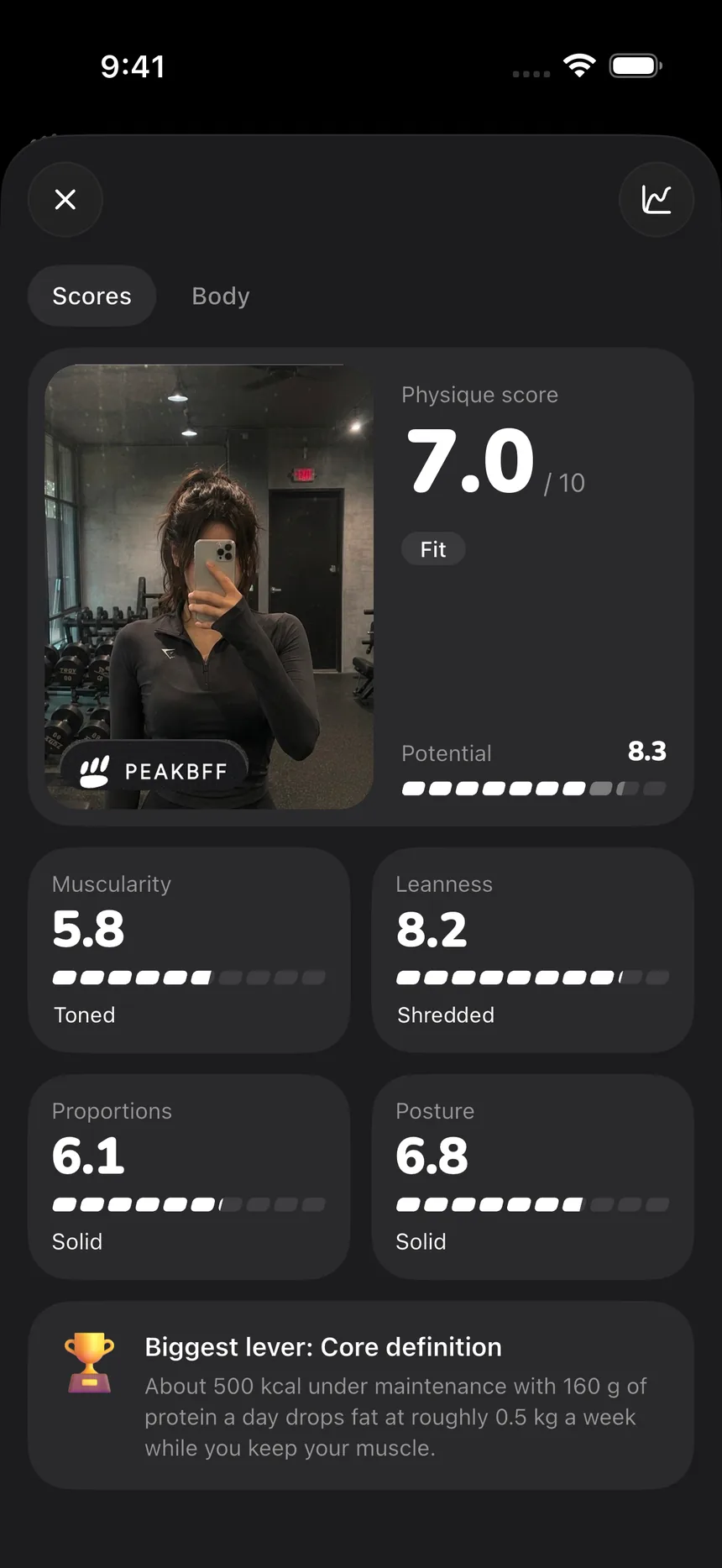
If you are deciding between dedicated progress tools, our AI physique rating app comparison explains the trade-offs and why estimates should be read as estimates.
Download PeakBFF on iOS or Android to keep physique check-ins alongside the gym work you actually log.
Questions, answered
How do you calculate shoulder-to-waist ratio?
Divide your shoulder circumference by your waist circumference, both in the same unit. Shoulders of 118 cm and a waist of 78 cm give 118 ÷ 78, which is 1.51. Keep the same tape, stance and landmarks every time so changes in the number reflect your body, not your technique.
What is a good shoulder-to-waist ratio?
There is no medical target. Online guides often cite 1.618, the golden ratio, as a bodybuilding ideal, but it is an aesthetic reference, not a health standard. Your own trend measured the same way is more useful, and tape and straight-line width methods give different numbers.
Where do you measure your waist for waist-to-shoulder ratio?
Use one fixed landmark and keep it. The World Health Organization's survey protocol measures at the midpoint between the lowest rib and the top of the hip bone, with the tape horizontal and snug, after a normal exhale. Whichever landmark you pick, repeat it exactly.
Is shoulder-to-waist ratio the same as waist-to-shoulder ratio?
They use the same two measurements, just divided the other way round. Shoulder-to-waist is shoulders ÷ waist, so a wider-shouldered, narrower-waisted body scores higher. Waist-to-shoulder is waist ÷ shoulders and gives the inverse. Pick one direction and stick with it in your log.
Can an app measure shoulder-to-waist ratio from a photo?
Some can estimate it. PeakBFF's Rate my physique, free to use, includes a shoulder-to-waist figure and a V-taper label in its analysis, but it is an estimate of shoulder width against waist width from your photo. It is not a tape measurement, so keep the two logs separate.
How often should you measure your shoulder-to-waist ratio?
Once every two to four weeks is plenty. Body measurements move slowly, and tape error can be a centimeter or more, so frequent checks mostly record noise. Measure at the same time of day under similar conditions, and compare raw numbers and photos as well as the ratio.
More from PeakBFF
More app comparisons, fitness guides, and product notes.
JEFIT vs Fitbod (2026): Exercise Library or AI Workout Generator?
Compare JEFIT and Fitbod for gym tracking, AI workout generation, exercise libraries, and pricing, plus how PeakBFF unifies lifting and macros.
How to Track Muscle Growth: What to Measure, Realistic Rates, and Progress Log Template
Learn how to track muscle growth accurately: gym performance proxies, tape measurements, progress photos, and rolling scale weight. Includes audit template.
MacroFactor vs Cronometer (2026): Adaptive Macro Coach or Micronutrient Tracker?
MacroFactor vs Cronometer compared for lifters in 2026. Explore adaptive TDEE coaching, 80+ micronutrient tracking, food logging UX, pricing, and how PeakBFF compares.
Ladder vs Peloton (2026): Guided Strength Teams or Studio Classes?
Ladder vs Peloton compared for lifters in 2026. Explore team-based strength blocks, studio video classes, progressive overload, prices, and how PeakBFF compares.
MeThreeSixty vs ZOZOFIT (2026): Which 3D Body Scanner Fits Lifters?
Compare MeThreeSixty and ZOZOFIT for 3D body scanning, circumferences, and body fat estimates, and see which app best supports a lifting routine.
Hevy vs Strong (2026): Which Gym Workout Log Fits Your Training?
Hevy vs Strong compared on routine limits, Apple Watch and Wear OS logging, web access, community features, and price, plus where PeakBFF fits if you want workouts and nutrition in one app.