Cardio Before or After Lifting? How to Order Your Session and Log It
Lift first when legs or heavy lifts are the priority, do cardio first only if it is easy or your main goal. Here is the evidence, a decision table and a way to log it.
Cardio Before or After Lifting? How to Order Your Session and Log It
If building strength or muscle is your main goal, lift first and do cardio after. If running, cycling or a race is your main goal, do the cardio first. A short, easy warm-up of 5 to 10 minutes before lifting is fine in both cases. The rule underneath is simple: do the thing you care about most while you are fresh.
That is a rule of thumb, not a law. The evidence for order is thin and the effect is small, so the best order is mostly the one you will actually follow and can repeat. This page gives you the evidence in plain terms, a table that picks an order for your situation, and a simple way to test it on yourself and log the result.
What does the research say about cardio before or after weights?
The most useful study for this question is a systematic review and meta-analysis of trials that compared strength-then-endurance with endurance-then-strength sessions, by Murlasits, Kneffel and Thalib (2018). It found two things:
- Lower-body strength was a little higher when lifting came first. The pooled difference in the one-rep max was about 4 kg, with a wide margin of error (roughly 1 to 7 kg).
- Aerobic fitness did not depend on order. Maximal oxygen uptake (VO2 max) came out about the same either way.
Read that as a nudge, not a verdict. The gap is small, and a few kilograms on a one-rep max matter more to some lifters than others. It does line up with common sense: tired legs lift less, and lifting less is how strength stalls.
A wider look at mixing cardio into lifting is reassuring. A 2022 meta-analysis of 43 studies found that adding aerobic training to lifting did not clearly reduce maximal strength compared with lifting alone, though explosive strength showed a small deficit. See Schumann et al., 2022, Sports Medicine. So cardio is not the enemy. The question is mostly what it costs your next set.
Which order should you pick? A simple decision table
Match your main goal to an order, then adjust for the day:
| Your situation | Do this first | Then | Why |
|---|---|---|---|
| Strength or muscle is the goal | Weights | Cardio, 10 to 30 easy minutes | Heavy sets need fresh legs and a fresh mind |
| Leg day (squat, deadlift, leg press) | Weights | Easy cardio, or none | Cardio first can cap how much you lift |
| Upper-body day | Either works | Either works | Walking or cycling barely touches your arms and back |
| Running, cycling or a race is the goal | Cardio | Short, lighter lifting | Protect the quality of the sessions that matter most |
| You are short on time | The priority | Whatever is left, shortened | A short second half beats a skipped first half |
| You only want a warm-up | 5 to 10 easy minutes | Lift | It warms you up without tiring you |
| Hard intervals (HIIT) | Own day, if possible | Or after lifting | Hard efforts can leave your legs too tired to lift well |
Two notes on the table. First, "easy" means you can talk in full sentences. If you are not sure of your range, our guide to tracking zone 2 cardio next to your lifting shows how to set it. Second, if you can split the work, doing cardio on a different day or several hours apart removes the fatigue problem altogether. Our rest day scheduling templates help you place the days.
Does cardio before lifting really hurt your lifts?
It depends on the cardio. Ten easy minutes is a warm-up. Forty minutes of hard running before squats is a different workout, and your legs know it.
Use this quick check on any day you do cardio first:
- Note your first working set on your first heavy lift: weight, reps and how hard it felt.
- Compare it with the same set from your last session without cardio first.
- If the weight or reps dropped, or the same set felt clearly harder, the cardio cost you something. Shorten it, make it easier, or move it after.
Heat, sleep, food and stress also change how heavy a day feels. One bad day is not proof. Look at two or three sessions in a row before you change your plan.
How do you test your own order for two weeks?
Do not guess. Run a small experiment and let your log decide.
- Pick one repeating lifting day, ideally lower body or full body.
- For two sessions, do your normal cardio before lifting. For the next two, do it after. Keep the cardio the same: same machine, same time, same effort.
- After each session, write down the numbers below.
Copy this line into any note:
DATE: ______  ORDER: [ ] cardio first  [ ] lifting first
CARDIO: ____________ (machine) ____ min  ____ distance
FIRST HEAVY SET: ________ lb x ____ reps   FELT: [ ] easy  [ ] ok  [ ] hard
LAST SET OF THE LIFT: ________ lb x ____ reps
ENERGY FOR THE SECOND PART (1-5): ____
And a filled example:
Oct 27  ORDER: cardio first
CARDIO: Stationary bike 20 min, 6.1 mi
FIRST HEAVY SET: 205 lb x 5 reps  FELT: hard
LAST SET OF THE LIFT: 205 lb x 3 reps
ENERGY (1-5): 2
Nov 3 ORDER: lifting first
CARDIO: Stationary bike 20 min, 6.0 mi
FIRST HEAVY SET: 205 lb x 5 reps FELT: ok
LAST SET OF THE LIFT: 205 lb x 5 reps
ENERGY (1-5): 3In that made-up example, the last set held at five reps when lifting came first, and the bike distance barely changed. That is a reason to keep lifting first. If your numbers show no difference, pick the order you enjoy more.
How do you set the order in PeakBFF?
PeakBFF logs cardio and lifts in the same workout, so the order is just the order of the exercises:
- Start your workout, open the workout menu (the Workout sheet) and choose Add exercise. Search for a cardio exercise such as Stationary Bike, Incline Treadmill Walk, Rowing Machine or Outdoor Cycling.
- Cardio uses a time and distance row instead of weight and reps. Enter the distance and duration, then tap the check. Distance follows your Units setting, so it is in miles with imperial units. Duration is entered in seconds, so 20 minutes is 1200.
- To change the order, open the workout menu again and choose Reorder exercises. Press and hold an exercise, then drag it to the start or the end of the list.
- After your first heavy set, choose Add note in the workout menu and write the order and how it felt, for example "cardio first, 205 for 5 felt hard". Our workout notes template keeps notes short.
- Next time, tap Previous on each exercise to see what you did last time, so the comparison is one glance, not a search through old workouts. The exercise history page shows past sessions of the same lift.
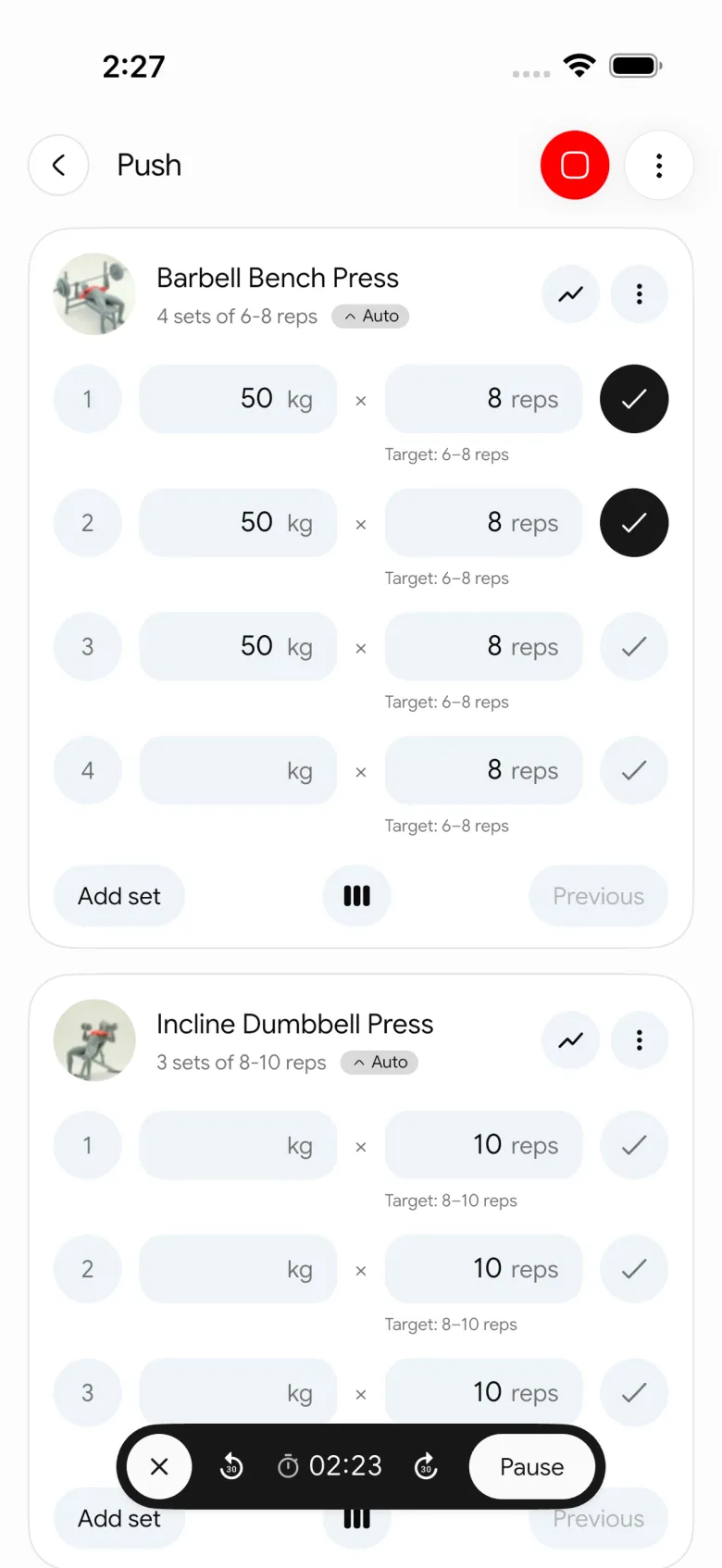
PeakBFF records what you did. It does not decide your order or measure how tired you felt, so the note is how you keep that part. See our guide to timed exercises and distance for the cardio row in more detail.
If you want food and protein in the same app as your cardio and lifts, see our comparison of the best apps to track workouts and macros.
How much cardio fits with lifting each week?
The Physical Activity Guidelines for Americans recommend 150 to 300 minutes of moderate aerobic activity a week for adults, plus muscle-strengthening activity on two or more days. A lifter does not need to hit the top of that range to benefit, and the order within a session matters far less than whether you do the sessions at all. If your weekly volume is already high, our deload week planner shows when to ease off.
If you have a heart condition, take medication that changes your heart rate, or feel chest pain or dizziness during exercise, talk with a clinician before adding cardio.
The simplest rule to take to the gym
Do the thing that matters most first. For most lifters that is weights, then easy cardio. Use a short easy warm-up if it helps, keep hard intervals on their own day when you can, and let two weeks of notes settle any argument. Many features are free for basic users, including workout logging, and you can start on iOS or Android.
Questions, answered
Should I do cardio before or after lifting?
If building strength or muscle is your main goal, do weights first and cardio after. Lifting fresh lets you move more weight on heavy lifts. If running or cycling is your main goal, do cardio first. A short, easy 5 to 10 minute warm-up before lifting is fine either way.
Does cardio before lifting kill your gains?
Not by itself. A meta-analysis of training-order trials found lower-body strength gains were slightly higher when lifting came first, by about 4 kg on the one-rep max, and the range was wide. Easy cardio rarely hurts. Hard cardio before squats or deadlifts can leave your legs too tired to lift well.
Is 10 minutes of cardio before lifting okay?
Yes. Ten easy minutes on a bike, rower or incline walk raises your heart rate and warms you up without tiring your legs much. Keep it easy enough to hold a conversation. If your first working set feels heavier than usual afterward, shorten or skip the warm-up on leg days.
Is it better to do cardio and weights on separate days?
Separate days, or sessions several hours apart, avoid the fatigue problem entirely, and they are a good option if you can schedule them. When you only have one slot, put the priority first: weights for strength goals, cardio for endurance goals, and keep the second part shorter.
How do I track cardio and weights in the same workout?
Add the cardio as an exercise in the same workout, log its time and distance, and put it before or after your lifts. In PeakBFF the workout menu has Add exercise and Reorder exercises, so you can drag cardio to the start or end. Many features are free for basic users, including workout logging.
More from PeakBFF
More app comparisons, fitness guides, and product notes.
Ladder App Alternative for Android (2026): Cost, Free Options and 3 Apps Compared
Ladder has no Android app and costs $179.99 a year after a trial. Compare Boostcamp, Alpha Progression and PeakBFF on price, free tiers, programmes and food tracking.
Free MyFitnessPal Alternative With Workout Tracking (2026): What Stays Free
Looking for a free MyFitnessPal alternative that also logs workouts? Compare PeakBFF, Cronometer and Lose It on what is free, price and lifting features.
Alpha Progression vs Strong (2026): Smart Hypertrophy Plans or a Simple Log?
Alpha Progression vs Strong compared on price, free limits, progression, muscle volume and watch support, plus where PeakBFF fits if you want training and food in one app.
RPE Chart for Lifting: RPE to Reps in Reserve to % of 1RM, With a Log Template
Use an RPE chart to turn how hard a set felt into reps in reserve and a percent of your 1RM. Includes a printable table, a worked example, and a way to log RPE in PeakBFF.
Best Free Strength Training App for Women Over 40 (2026): What Stays Free
Looking for a strength training app for women over 40 that does not lock logging behind a subscription? Hevy, Strong, Boostcamp, StrongEra and PeakBFF compared on what is free.
How to Track Zone 2 Cardio Next to Your Lifting: Heart Rate Range and Log Template
Find your zone 2 heart rate range with a simple formula and the talk test, then log each session next to your lifting. Includes an age table and a log template.