How to Calculate Strength Level From a Working Set: Formulas, Ratios, and Standards
Calculate your strength level from any working set using 1RM formulas and bodyweight multipliers. Compare bench, squat, deadlift, and press standards.
How to Calculate Strength Level From a Working Set: Formulas, Ratios, and Standards
To calculate your strength level from a working set, first estimate your one-rep max using the Epley formula: Weight × (1 + Reps / 30). Next, divide that estimated max by your current body weight to determine your relative strength multiplier (for example, a 160 lb lifter benching an estimated 200 lb achieves a 1.25x bodyweight ratio). Finally, compare that ratio against established benchmarks for your sex and weight class, where 1.0x to 1.25x marks intermediate strength for the bench press, 1.5x for the squat, and 1.75x to 2.0x for the deadlift.
A strength level is not an arbitrary badge or a medical diagnosis. It is a standardised mathematical comparison built from completed work, an accurate one-rep max estimate, and an appropriate comparison cohort. That is why two lifters moving the same absolute weight can hold different strength tiers depending on their body weight, sex, and equipment setup.
Use the reference tables, formulas, and logging template below to find your current strength tier and track your progress over time.
The 3-step formula to calculate strength level
You do not need to test a true maximal single in the gym to determine your strength level. In fact, attempting an unspotted 1RM often leads to form breakdown and unnecessary fatigue. Instead, use a completed working set of 3 to 8 controlled repetitions.
Step 1: Estimated 1RM = Weight × (1 + Reps / 30)
Step 2: Strength Multiplier = Estimated 1RM ÷ Body Weight
Step 3: Compare Multiplier against Standard Tiers (Beginner, Novice, Intermediate, Advanced, Elite)
Worked calculation example
Suppose a male lifter weighing 176 lb (80 kg) completes a clean working set of barbell squats with 225 lb (102 kg) for 5 reps:
- Calculate Estimated 1RM: 225 × (1 + 5 / 30) = 225 × 1.1667 = 262.5 lb (119 kg)
- Calculate Bodyweight Ratio: 262.5 lb ÷ 176 lb = 1.49x body weight
- Determine Strength Tier: Comparing 1.49x against male squat benchmarks places this lifter right at the threshold of the Intermediate tier (1.5x body weight).
If you are setting up your barbell and need to verify the exact plates on each sleeve, use our guide on how to calculate barbell weight with plates.
Big 4 strength standards by bodyweight ratio
Strength benchmarks differ across movements because of muscle group size, mechanical leverage, and range of motion. The tables below outline standard strength-to-bodyweight multipliers for the primary barbell lifts across five standard experience tiers.
Strength standards for men (multiplier of body weight)
| Lift | Beginner | Novice | Intermediate | Advanced | Elite |
|---|---|---|---|---|---|
| Barbell Bench Press | 0.75x | 1.00x | 1.25x | 1.50x | 1.85x+ |
| Back Squat | 1.00x | 1.25x | 1.50x | 2.00x | 2.40x+ |
| Deadlift (Conventional/Sumo) | 1.25x | 1.50x | 1.85x | 2.25x | 2.75x+ |
| Overhead Press (Standing) | 0.50x | 0.65x | 0.80x | 1.00x | 1.20x+ |
For a comprehensive breakdown of bench benchmarks across specific weight classes, see our complete guide to bench press strength standards.
Strength standards for women (multiplier of body weight)
| Lift | Beginner | Novice | Intermediate | Advanced | Elite |
|---|---|---|---|---|---|
| Barbell Bench Press | 0.45x | 0.65x | 0.85x | 1.05x | 1.30x+ |
| Back Squat | 0.75x | 1.00x | 1.25x | 1.60x | 2.00x+ |
| Deadlift (Conventional/Sumo) | 0.90x | 1.20x | 1.50x | 1.90x | 2.30x+ |
| Overhead Press (Standing) | 0.35x | 0.45x | 0.55x | 0.70x | 0.85x+ |
What each strength tier represents
- Beginner: You are learning fundamental movement patterns, bar path, and foot placement. You can move the empty Olympic bar and light bumper plates with control.
- Novice: Consistent training for 3 to 9 months. You have developed core stability and can bench close to body weight (for men) or squat your body weight (for women).
- Intermediate: Consistent, structured training for 1 to 2 years. A male lifter at this stage can typically bench press 225 lb (two plates) and squat 315 lb (three plates).
- Advanced: 3 to 5+ years of dedicated progressive overload. Your numbers place you among the strongest lifters in an ordinary commercial gym.
- Elite: Top competitive tier, matching tested strength athletes in the top 5% of sanctioned powerlifting federations.
Why simple bodyweight multipliers skew: allometric scaling
Whilst linear bodyweight multipliers (like 1.5x body weight) are quick to calculate, they naturally favour lighter athletes.
This discrepancy stems from allometric scaling. Muscular force capacity scales with the cross-sectional area of muscle fibres (a two-dimensional measurement in square centimetres). However, total body weight scales with physical volume (a three-dimensional measurement in cubic centimetres). As a lifter gains muscle mass and body weight, their body weight increases faster than their relative force generation.
For instance, a 130 lb lifter squatting 2.0x body weight moves 260 lb, an achievable milestone after several years of focused training. By contrast, a 240 lb heavyweight squatting 2.0x body weight must lift 480 lb, which demands exceptional neurological drive and skeletal density.
Validated powerlifting formulas (such as DOTS and Wilks) and sports science benchmarks apply an exponential allometric curve rather than a simple linear multiplier to normalise comparisons across weight classes fairly.
Strength level tracking template
To track your strength level over consecutive training cycles, use a structured log. Record the completed working set, your body weight on the day of the lift, and the resulting calculation:
| Date | Exercise variation | Completed set | Body weight | Estimated 1RM | Ratio | Strength tier | Notes |
|---|---|---|---|---|---|---|---|
| Sep 10 | Barbell Bench Press (paused) | 185 lb × 5 | 175 lb | 216 lb | 1.23x | Novice / Inter | Solid form, 3 min rest |
| Oct 08 | Barbell Bench Press (paused) | 195 lb × 5 | 176 lb | 227 lb | 1.29x | Intermediate | Touched chest cleanly |
| Nov 05 | Barbell Bench Press (paused) | 205 lb × 4 | 175 lb | 232 lb | 1.33x | Intermediate | Set personal record |
By tracking both the raw performance and the relative bodyweight ratio, you can see whether strength gains stem from true progressive overload or simply bodyweight fluctuations during a bulk or cut. To learn how to systematically increase your working weights, read our guide on how to track progressive overload.
Common calculation mistakes to avoid
- Calculating 1RM from sets above 10 reps: Formulas like Epley and Brzycki lose accuracy as repetitions increase beyond 8 to 10. High-rep sets reflect muscular endurance, cardiovascular conditioning, and lactate tolerance as much as raw strength.
- Comparing different exercise variations: A touch-and-go bench press, a competition-paused bench press, and a close-grip bench press produce distinct load capacities. Never compare a working set from one variation against the standard for another.
- Ignoring equipment differences: Machine chest presses, Smith machines, and cable movements incorporate internal friction, varying leverage curves, and counterweights. Restrict standardised strength level calculations to free-weight barbell compound lifts.
- Using planned weights rather than completed reps: Always base your calculation on the actual completed repetitions where technical form remained intact. Grinding through a rep with hitched hips or an unstable bar path produces an inaccurate benchmark.
If you want to review the underlying formula maths in detail, explore our one-rep max calculator and formula guide.
How PeakBFF calculates strength ranks
PeakBFF features a dedicated in-app Rank Calculator and Muscle Strength Rank system that automates these calculations directly from your live workout log:
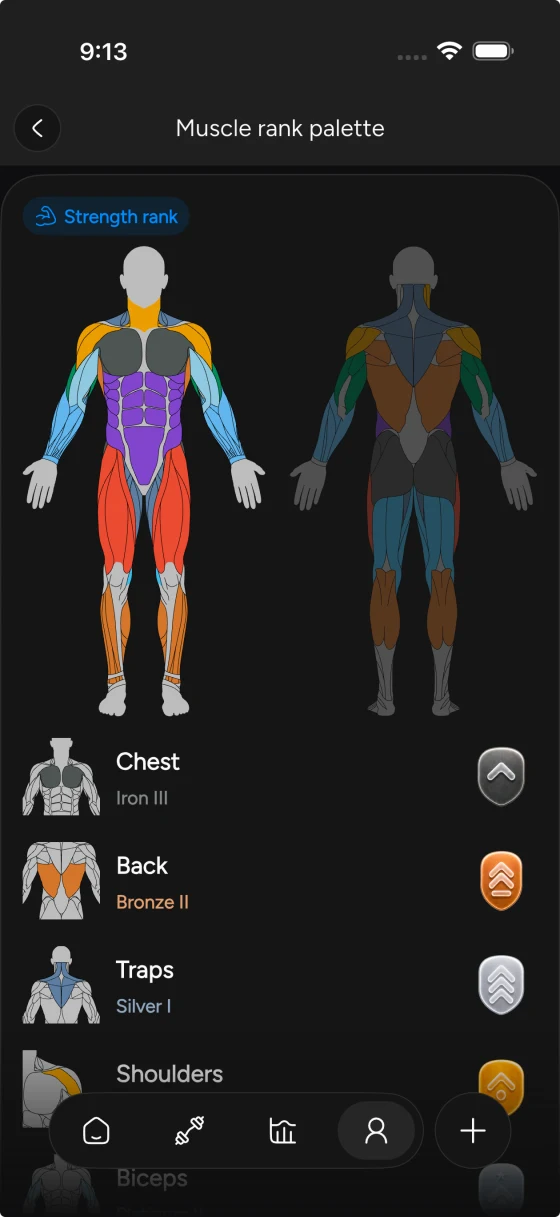
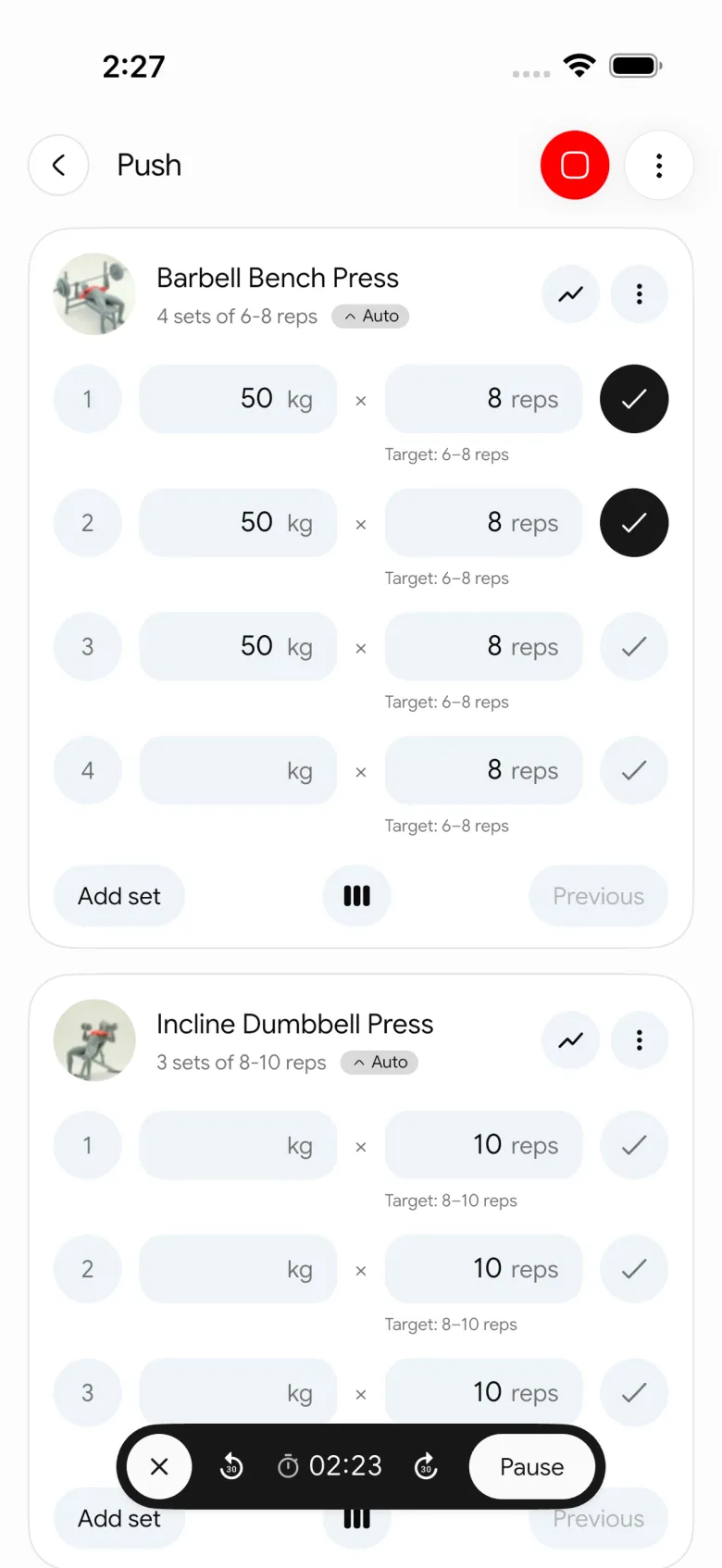
- Select a supported exercise: Open the Rank Calculator and select a supported compound movement (such as Barbell Bench Press, Barbell Squat, or Deadlift).
- Enter completed load and reps: Input your actual completed working set. PeakBFF automatically prefills weights and reps from your recent session history if you logged it in the app.
- Provide body weight and sex: The calculator uses your logged weigh-in history and biological sex to calibrate appropriate standard curves.
- Reveal your rank and tier: The app maps your performance across 10 progressive tiers: Iron, Bronze, Silver, Gold, Platinum, Emerald, Diamond, Master, Grandmaster, and Challenger, each subdivided into divisions (III, II, and I).
- Clear unranked safeguards: If essential data is missing (such as body weight for relative lifts, or rep counts outside valid bounds), PeakBFF keeps the result unranked rather than displaying an uncalibrated guess.
To compare different apps that offer strength standards and automated ranking, read our roundup of the best strength standards apps for gym lifters.
The practical takeaway
Calculate your strength level using a completed working set, the Epley formula, and your current body weight. Use the resulting tier as a reference point for your training cycles, not as an ego contest or a universal verdict. The true value of a strength rank lies in seeing your relative strength increase steadily over months of consistent training.
To log your sets, track personal records, and calculate your strength rank in one app, download PeakBFF for iOS or Android.
Questions, answered
How do I calculate my strength level from a working set?
First, estimate your one-rep max from a completed set using the Epley formula: Weight × (1 + Reps / 30). Next, divide that estimated max by your body weight to calculate your strength multiplier (for example, a 200 lb bench press at 160 lb body weight gives a 1.25x ratio). Finally, compare that multiplier against standard strength tiers for your sex and weight class.
What are respectable strength-to-bodyweight ratios for lifters?
For natural male lifters with 1 to 2 years of consistent training, intermediate milestones typically equal 1.25x body weight for the bench press, 1.5x body weight for the squat, and 1.75x to 2.0x body weight for the deadlift. For female lifters, intermediate milestones are approximately 0.85x body weight for bench press, 1.25x for squat, and 1.5x for deadlift.
Do I need to test a true one-rep max to find my strength rank?
No. Testing a maximal single under heavy load carries injury risk and requires extended recovery. Taking a solid working set of 3 to 5 controlled repetitions and using an established formula gives an accurate, repeatable benchmark without technical form breakdown.
Why do simple bodyweight multipliers favour lighter lifters?
Muscular force production scales with muscle cross-sectional area in two dimensions, while body weight scales with physical volume in three dimensions. As lifters become heavier, their body mass increases faster than muscle area, meaning a 220 lb lifter benching 1.5x body weight must produce significantly more absolute power than a 150 lb lifter.
How does PeakBFF calculate strength rank tiers?
PeakBFF includes a built-in Rank Calculator that turns completed sets of supported lifts into bounded benchmarks across 10 tiers (from Iron to Challenger) and divisions (III, II, I). The calculation uses verified competition and gym-cohort data, requiring biological sex, entered load and reps, and body weight.
Can I calculate strength levels for dumbbell and machine exercises?
Standards for dumbbells and machines are equipment-dependent and vary widely across pulley ratios, seat angles, and lever arms. For non-barbell movements, focus on personal session-to-session progression and estimated 1RM trends rather than universal competition tiers.
More from PeakBFF
More app comparisons, fitness guides, and product notes.
How to Calculate Macros for Body Recomposition: Formula, Step-by-Step Calculator, and Tracking Guide
Calculate your daily macros for body recomposition with the step-by-step formula for calories, protein, fats, and carbs, complete with a worked calculation and tracking template.
Arnold Split vs PPL (2026): Muscle Hypertrophy, Routine Breakdown, and How to Track Both
Compare the Arnold Split vs Push Pull Legs (PPL): muscle pairings, arm and shoulder growth, 6-day and hybrid routines, volume rules, and how to track both.
Alpha Progression vs RP Hypertrophy (2026): Which Hypertrophy App Fits Lifters?
Alpha Progression vs RP Hypertrophy App compared on volume landmarks, progressive overload algorithms, pricing, gym logging, and where PeakBFF fits.
Double Progression Method: How It Works, Rep Ranges, and Log Template
Master the double progression method: increase reps first, then weight. Learn rep ranges, standard vs dynamic double progression, worked tables, and how to track it.
Lose It vs MyFitnessPal (2026): Which Calorie Tracker Fits Lifters?
Lose It vs MyFitnessPal compared on database accuracy, free barcode scanning, pricing, and gym tracking, plus where PeakBFF fits for lifters who want both.
Best Before and After Photo App for Gym Progress (2026): 4 Options Compared
Compare the best before and after photo apps for gym lifters in 2026: Progress, SnapTrack, Hevy, and PeakBFF, covering sliders, ghost overlays, privacy, and prices.