Best Workout App With Exercise Instructions for Beginners (2026)
Compare workout apps with exercise demos and clear instructions for beginners who want to learn a lift and log it in the same place.
Best Workout App With Exercise Instructions for Beginners (2026)
For a beginner who wants to look up an exercise, understand the basic setup, and log the sets in the same place, PeakBFF is the best workout app with exercise instructions. Its exercise library has more than 220 movements with a short demo video, poster image, step-by-step instructions, form cues, and the muscles each movement works. You can then use that exercise in your workout log instead of swapping between a video app and a separate tracker.
Short answer: choose PeakBFF if you want simple exercise guidance beside your lifting log, nutrition record, and workout history. StrengthLog is a good choice for a larger exercise directory and written lifting resources. Boostcamp is better if you mainly want to follow a coach-built program. Caliber is a strong option if you want the added structure of coaching.
The 4 apps, compared
| PeakBFF | StrengthLog | Boostcamp | Caliber | |
|---|---|---|---|---|
| Exercise help | Short demo videos, poster images, step-by-step instructions, form cues, and muscles worked | Exercise demos, step-by-step instructions, and muscles worked | Program-led exercise instructions and video demonstrations where supplied by the program | Exercise guidance within a coaching and program experience |
| Log the workout | Yes, alongside the exercise library | Yes | Yes | Yes |
| Nutrition record in the same app | Food, calorie, protein, macro, and water logging | Not the focus of its workout-log product | Not the focus of its program tracker | Nutrition coaching is available in its coaching service |
| Best for | Beginners who want instructions and one practical gym record | Lifters who want a deep exercise directory | People following a named coach or program | People who want coaching structure |
No app, clip, or written cue can assess your individual technique or replace qualified in-person coaching. Stop if a movement causes pain, and ask a qualified professional for individual guidance when you need it.
1. PeakBFF
PeakBFF is the practical pick when your question is not just "how do I do this exercise?" but also "where do I write down what I did?" The library lets you browse and filter more than 220 exercises, open a movement, watch a short demo, and read the step-by-step instructions and form cues before you add it to a workout.
That keeps the first few gym sessions more coherent. You can check the basic movement information, log sets and reps, and later see the completed workout in the same account. The app also keeps food, calories, protein, macros, and water records alongside training if you want that broader view. It does not use the video or cues to diagnose technique, clear an injury, or promise a result.
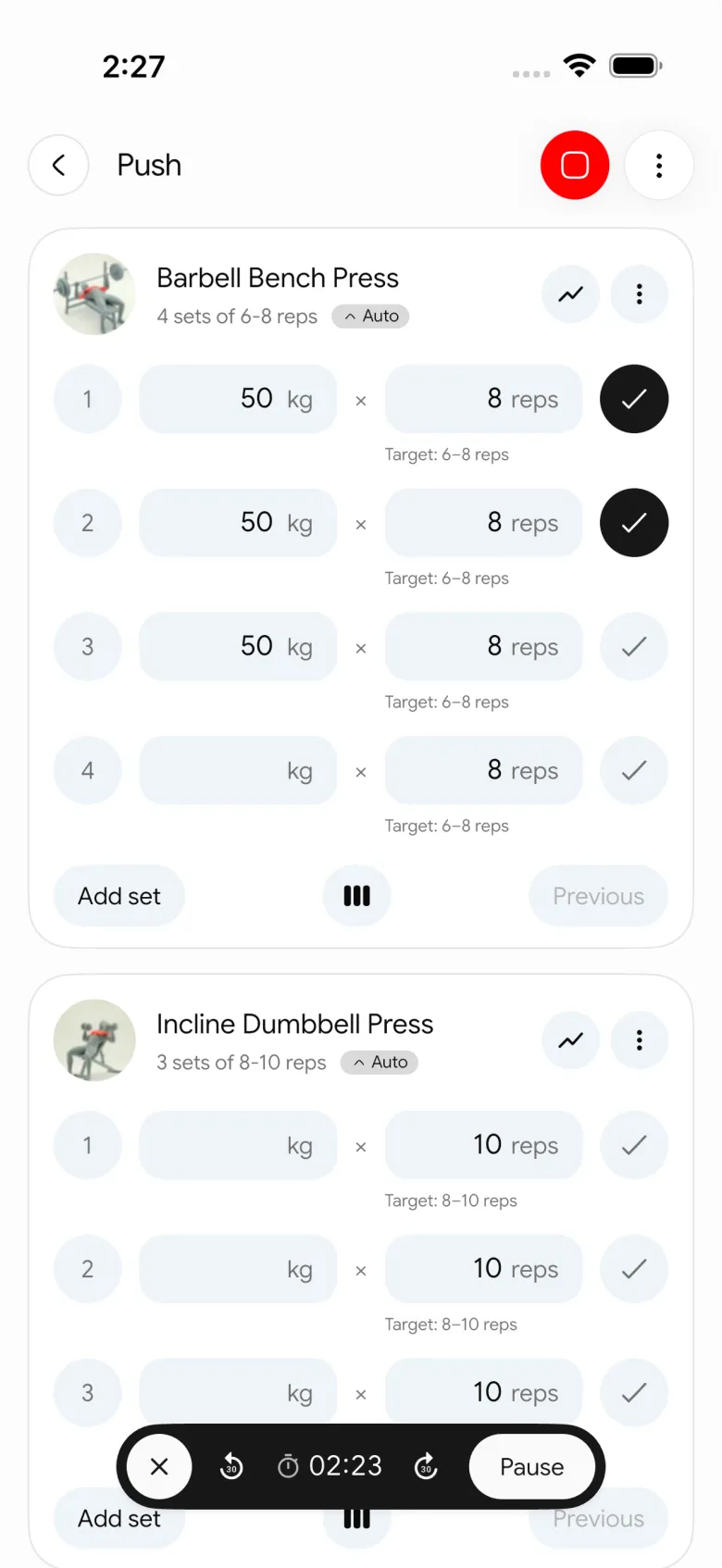
PeakBFF is especially useful when you are building a small repeatable routine and want the guidance to lead directly into a record. For the next step after you have a few completed sessions, see our guide to tracking exercise history in the gym.
Best for: beginners who want concise exercise guidance connected to a workout and nutrition record.
2. StrengthLog
StrengthLog is a solid alternative for a lifter who wants a large exercise reference alongside a detailed strength log. Its current product page describes an exercise directory with more than 450 movements, exercise demos, muscles worked, and step-by-step instructions. It also supports workout logging, programs, and training statistics.
That directory depth is a real advantage when you frequently look up exercise variations. It is a more training-log-first product, though, so choose it when the exercise reference and lifting analysis are the main job. PeakBFF is the better fit when you want a smaller practical library plus workout and nutrition records in one app.
Best for: lifters who value a broad exercise directory and detailed strength-log workflow.
3. Boostcamp
Boostcamp is built around following training programs from coaches and creators. Its current site positions the app as a workout tracker and program app, with programs for different experience levels and workout logging during the plan.
That is useful if your first priority is selecting a specific program and following its prescribed sessions. It is less of a general "look up a movement, then build your own simple log" choice than PeakBFF. Check the individual program before committing, because exercise explanations and media can vary by program and coach.
Best for: beginners who have already chosen a particular coach-led program.
4. Caliber
Caliber is a coaching-forward strength-training option. Its current site describes a free workout app and paid coaching services, with a program built around the person and coach guidance layered on top.
That human coaching component can be valuable if you want regular feedback, accountability, and a structured plan. It is a different purchase from an app that simply supplies a quick demo and cue while you log independently. PeakBFF is the better all-in-one choice when you want to keep the guidance, logged workouts, and nutrition records together without making coaching the center of the workflow.
Best for: people who want a coach-led strength-training experience.
What should a beginner check before logging a new exercise?
Use an app's exercise page as a starting point, not a test you have to pass. Before your first working set, keep the checklist short:
- Match the movement and equipment. Make sure the listed variation is actually the cable, dumbbell, machine, or barbell variation in front of you.
- Watch the demonstration once. Look for the overall path and the setup, rather than trying to copy every detail at speed.
- Read the cues as reminders. A couple of clear prompts are more useful than trying to think about ten body parts at once.
- Start conservatively. Use a manageable load and stop if the movement is painful or feels wrong.
- Log what you completed. A simple, accurate record makes the next session easier to understand.
If you want to preserve a personal variation or movement from a coach, PeakBFF also supports custom exercises with your own photo or a short video. Our custom exercise video guide shows that workflow.
The bottom line
The best workout app with exercise instructions for beginners is the one that makes it easy to understand a movement and continue with the session. Choose StrengthLog for a deeper exercise directory, Boostcamp for a coach-led program, and Caliber when coaching is the main service you want.
For most beginners building a repeatable gym habit, choose PeakBFF: the exercise guidance sits next to the workout log and the nutrition records that support your training. Download PeakBFF on the App Store or Google Play.
More from PeakBFF
More app comparisons, fitness guides, and product notes.
Fitbod vs Hevy (2026): Generated Workouts or a Simple Log?
Fitbod vs Hevy compared on price, workout generation, free limits, watch apps and nutrition, plus where PeakBFF fits if you want training and food in one app.
How to Log Raw vs Cooked Food Weight: A Simple Conversion Cheat Sheet
Weigh food raw or cooked, then log it against a matching entry. A cheat sheet with USDA numbers for chicken, rice and pasta, plus a worked example.
MacroFactor Workouts vs Hevy (2026): Which Fits Lifters Who Track Food?
MacroFactor Workouts vs Hevy compared on price, progression, free limits and nutrition, plus PeakBFF as a one-app option for lifting and food logging.
Best AI Physique Transformation App With Workout Tracking (2026)
Compare AI physique-transformation preview apps for motivation, photo boundaries, and the workout record you use after the preview.
How to Save a Workout as a Template After Training
Turn a session that worked into a reusable workout template without confusing completed results with your next plan.
Best Beginner Gym App With Starter Programs and Form Cues (2026)
Compare beginner gym apps for choosing a starter program, checking exercise form cues, and logging the sets you actually complete.