Best App to Learn Cable Machine Exercises (2026)
Compare four gym apps for learning cable machine exercises with videos, basic instructions, and a practical lifting log.
Best App to Learn Cable Machine Exercises (2026)
For lifters who want to find a cable variation, check a short demo and a few basic cues, then log the sets they actually complete, PeakBFF is the best fit. Its exercise library lets you browse and filter more than 220 exercises, including cable equipment, then open a movement for a short demo video, step-by-step instructions, form cues, and muscles worked. The same exercise can then go straight into your workout log.
Short answer: choose PeakBFF when you want cable-machine guidance beside a simple gym log, plus optional food, calorie, protein, and macro records. Hevy is a strong alternative for its larger exercise library and equipment filters. Fitbod is compelling if you want cable movements inside adaptive workout generation. JEFIT is worth considering when a very large, searchable exercise database is the main draw.
The 4 apps, compared
| PeakBFF | Hevy | Fitbod | JEFIT | |
|---|---|---|---|---|
| Cable exercise discovery | Browse and filter the library, including cable equipment | Search and equipment or muscle filters across its exercise library | Exercise guides by muscle and cable-equipment category | Searchable database with muscle and equipment filters |
| Basic movement help | Short demo video, step-by-step instructions, form cues, and muscles worked where available | Demonstrational animation and step-by-step instructions | Professionally created videos and written coaching cues | Written steps for individual database entries |
| Log sets and reps | Yes | Yes | Yes | Yes |
| Food and protein record in the same app | Yes, when you log them | Not the focus of its library page | Not stated on its exercise-guide pages | Not stated on its exercise-database page |
| Best for | Learning a movement, then keeping one gym and nutrition record | A broad exercise library and social workout log | People who want exercises selected in generated workouts | Lifters who want the biggest searchable reference first |
No app video or written cue can judge your technique, clear you for exercise, or replace qualified in-person coaching. Stop when a movement is painful or does not feel right, and seek individual guidance when you need it.
1. PeakBFF
PeakBFF is the practical choice when the job is more than watching a clip. You can narrow the exercise library to the equipment in front of you, open a cable movement, use the demo and short instructions as a basic reference, and add it to the workout you are logging. That keeps the question "what is this cable exercise?" next to the useful follow-up: "what weight and reps did I complete?"
The library gives cable-machine beginners a concise starting point: a short demo video, poster image, numbered instructions, form cues, and the muscles a movement works. The cues are reminders, not personalised form analysis. They cannot see your setup, range of motion, history, pain, or the exact cable machine in your gym.
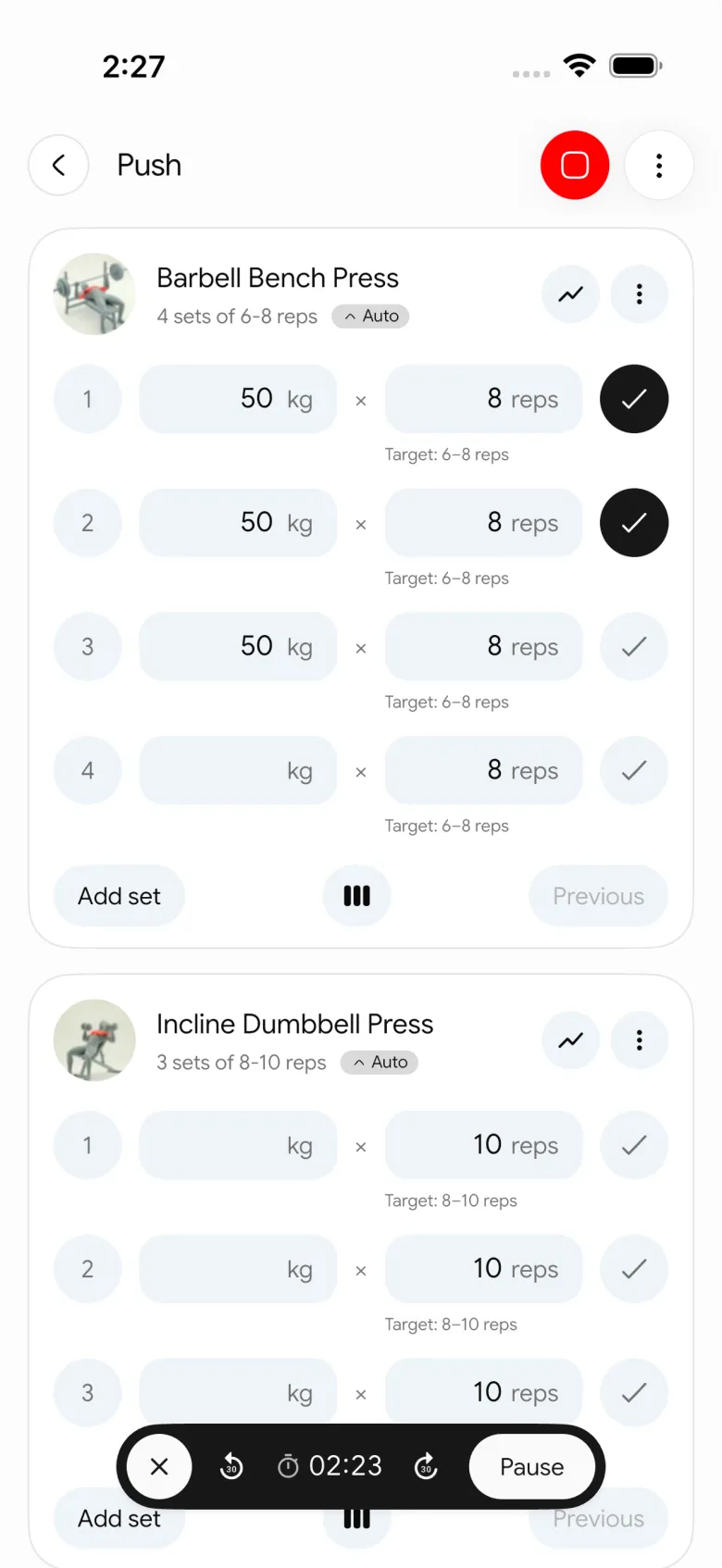
After you check the movement, PeakBFF keeps the next part simple: log the sets and reps you complete. If you also want food, calories, protein, macros, water, or bodyweight in the same daily record, those tools are available without turning an exercise demo into health advice. For a closer look at what happens after a session, read our guide to tracking exercise history in the gym.
Best for: lifters who want basic cable exercise help that leads directly into a practical workout and nutrition record.
2. Hevy
Hevy's exercise library is a strong option when library depth is the first priority. Its current feature page describes more than 400 exercises, a search tool, equipment and muscle-target filters, demonstration animations, and step-by-step instructions. It also includes cable and machine equipment among the library categories.
That makes Hevy a sensible pick if you regularly look up a variety of gym movements and want a detailed lifting log with a social element. It also lets you create custom exercises. Pick it if the broader directory is your main reason for installing. Pick PeakBFF when you want the cable reference, session log, and optional nutrition record together in one daily workflow.
Best for: lifters who want a larger exercise directory and a social, training-log-first experience.
3. Fitbod
Fitbod's exercise guides cover movements by muscle group and equipment, including several cable categories. Its public exercise pages provide a useful way to inspect a movement such as a cable row before you decide whether it belongs in a workout. Fitbod's current FAQ also describes a video demonstration and written coaching cues for every exercise.
Fitbod is especially relevant if you want an app to generate workouts and make exercise choices based on the equipment you have. That is a broader job than simply looking up a cable movement during a self-directed session. Choose Fitbod when workout generation is central to your decision. Choose PeakBFF when you want to browse a straightforward exercise reference and keep your logged workout and nutrition context close by.
Best for: people who want cable movements within a generated-workout experience.
4. JEFIT
JEFIT's exercise database is the specialist reference option in this comparison. Its current database page supports searching by muscle and equipment, and lists 1,295 exercises. Cable movements appear among the entries, with written step sequences for individual exercises.
That scale is useful when you want to search a lot of variations before building a routine. The trade-off is that an enormous database can be more than you need when you are standing by one cable stack and only need a clear, quick starting point. PeakBFF is the better all-in-one fit when you want basic instruction, completed sets, and the rest of your daily log in the same place.
Best for: lifters who want the largest searchable exercise reference in this group.
What to check before you start a cable exercise
The exact attachment, pulley height, seat, and machine can change a cable movement. Use an app guide to orient yourself, then pause before loading the first working set.
- Match the variation to the setup. A cable row, pulldown, pressdown, and fly use different attachments and starting positions. Make sure the guide names the movement you are trying to do.
- Watch the whole demo once. Look for the start position and the general path of the handle. Avoid trying to copy every detail at full speed.
- Use one or two cues. Treat them as simple reminders. They are not a pass or fail score for your form.
- Start with a manageable load. An introductory set gives you time to understand the machine and adjust the setup before recording a working set.
- Log what you actually completed. A clear session record is more useful than pretending every set matched a guide perfectly.
If the standard library does not include a movement or a coach has given you a specific variation, PeakBFF also supports custom exercises with your own photo or short video. Our custom exercise video guide shows that workflow.
The bottom line
The best app to learn cable machine exercises is the one that helps you match the movement in front of you, gives you a concise reference, and lets you keep a useful record afterwards. Hevy is a good fit for a large library, Fitbod for generated workouts, and JEFIT for a huge searchable database.
For most lifters who want cable exercise guidance that naturally becomes part of a repeatable gym habit, choose PeakBFF. Download it on the App Store or Google Play, check the movement, and keep a log of the work you actually complete.
More from PeakBFF
More app comparisons, fitness guides, and product notes.
Best AI Physique Transformation App With Workout Tracking (2026)
Compare AI physique-transformation preview apps for motivation, photo boundaries, and the workout record you use after the preview.
How to Save a Workout as a Template After Training
Turn a session that worked into a reusable workout template without confusing completed results with your next plan.
Best Beginner Gym App With Starter Programs and Form Cues (2026)
Compare beginner gym apps for choosing a starter program, checking exercise form cues, and logging the sets you actually complete.
How to Track Home and Gym Versions of the Same Exercise
Use a simple split-or-combine checklist to keep home and gym exercise variations clear in your workout history.
How to Log a Weigh-In in a Gym App: A Simple History Checklist
Log a weigh-in with a repeatable routine, a clear calendar day, and a simple history review that keeps your gym records useful.
How to Choose a Starter Workout Program: A 3-Question Template
Choose a starter workout program with a simple goal, schedule, and equipment template, plus a verified PeakBFF setup flow.