Body Fat Calculator (US Navy Method)
Enter your height, neck and waist, plus your hip if you are a woman, and get a body fat percentage estimate with the US Navy tape method. Add your weight and it splits it into fat mass and lean mass. It is an estimate: in a study of 609 Marines, the military circumference method differed from a DXA scan by about 4 percentage points from person to person. It runs in your browser and needs no account.
Just below the Adam's apple, tape level and not over it, shoulders down.
Around the belly button, tape level, after a normal breath out.
Add it to see fat mass and lean mass.
Example for a man at 178 cm with a 38 cm neck and 85 cm waist. Enter your own measurements above.

16.4 %
ACE row: Fitness
In the ACE chart, 16.4% falls in the "Fitness" row (14-17%).
- Essential fat2-5%
- Athletes6-13%
- Fitness14-17%
- Average18-24%
- Obese25% and higher
An estimate: the tape method can differ from a DXA scan by several points. Rows are from the American Council on Exercise chart for men.
Want to turn this into a fat-free mass index? Try the FFMI calculator.
Keep the number next to your progress
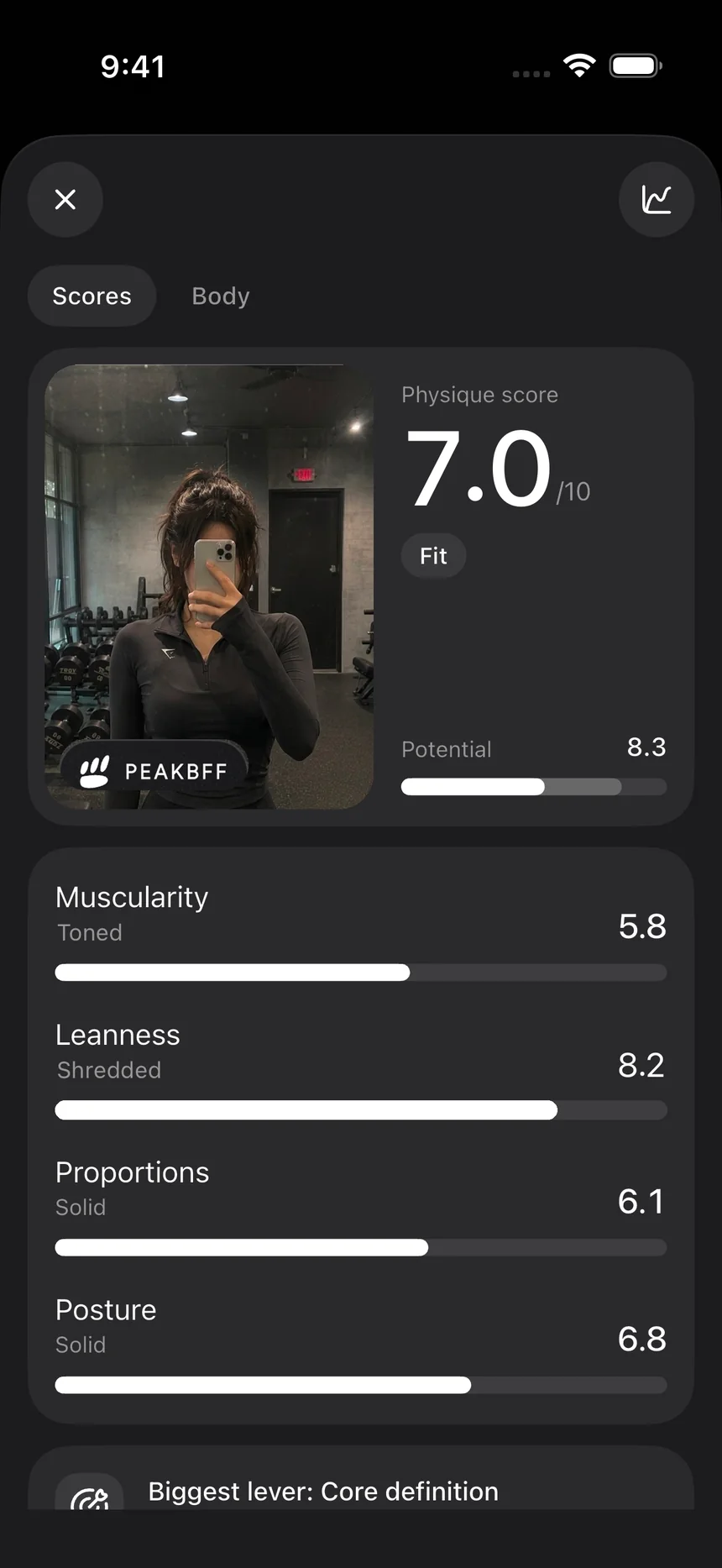
A body fat estimate means more beside your weigh-ins and photos. PeakBFF keeps your weight trend, and a weekly check-in adds an optional photo and note to that day's weigh-in. Its physique rating reads front and back photos and gives category scores and a muscle map, as motivation and not as a diagnosis.


How to measure with a tape
You need a flexible tape measure and a mirror or a helper. The measuring sites below follow the Department of Defense instruction that sets out the Navy method. Stand relaxed, measure against bare skin, and keep the tape level and snug without pressing in.
- Height: stand tall without shoes, looking straight ahead with your chin level.
- Neck: measure just below the larynx (Adam's apple), with the tape square to the neck and not over the Adam's apple. Look straight ahead and keep your shoulders down, so the shoulder muscles are not in the loop.
- Waist, men: measure around the abdomen at the navel, with the tape level with the floor and your arms at your sides. Read it at the end of a normal, relaxed breath out.
- Waist, women: measure the natural waist at the narrowest point of the abdomen, usually about halfway between the navel and the lower end of the breastbone. If the narrowest point is hard to see, take a few readings and use the smallest.
- Hip, women only: measure around the widest point of the buttocks as seen from the side, with the tape level with the floor.
- Go through the sites in turn, three times, and use the average of each. If one reading is more than 2.5 cm (1 inch) from the other two, measure again. Repeat at the same time of day.
The formula behind the estimate
The calculator uses the circumference equations of Hodgdon and Beckett (1984) from the Naval Health Research Center. They predict body density from the tape measurements, in centimeters, and then convert density to body fat percent with the Siri equation, 495 ÷ density − 450.
For men, density = 1.0324 − 0.19077 × log10(waist − neck) + 0.15456 × log10(height). For women, density = 1.29579 − 0.35004 × log10(waist + hip − neck) + 0.22100 × log10(height). The Department of Defense publishes the same equations in a direct inch form, and the two agree within about a point over the whole range and much closer for typical measurements.
Fat mass is your weight times the body fat percent. Lean mass is the rest: your weight minus fat mass. Lean mass includes muscle, bone, organs and water, so it is not the same as muscle mass.
How accurate tape methods are compared with DEXA
A tape estimate is a prediction from a few circumferences, so it carries error. In a study of 609 Marines (430 men and 179 women) who were measured with a tape and a DXA scan, the military circumference method (which uses the same kind of tape measurements) gave an estimate for men that read 2.5 to 2.6 points lower than DXA on average, and for women it read 1.3 to 2.3 points higher. Individual differences were wider, with a spread of 3.7 to 4.8 points. The error also depended on body fat: lean people were overestimated and people with more body fat were underestimated.
The authors concluded that the tape method works for screening and sorting people into groups, but does not provide research-grade body composition data. A separate study of 1,407 Army recruits found that the tape estimates tracked DXA with a standard error of 3.4 to 4.1 points before training. After eight weeks of training, DXA showed a drop in body fat in both sexes, while the tape estimate showed no change in women and a smaller change in men.
A DXA scan is a better single measurement, but it needs a scanner and an appointment. The tape method costs almost nothing and repeats easily, which is where it is most useful.
What to do with the number
Read it as a range, not a point. An estimate of 18 percent could sensibly sit a few points either side. Compare yourself with your own earlier readings, taken the same way, instead of with a friend's number or another calculator's.
Small changes are easy to mistake for noise. The American Council on Exercise notes that most body fat methods are prone to measurement error and suggests waiting a couple of months before rechecking. Watching your waist measurement, your weight trend and how your clothes fit alongside the estimate gives a fuller picture.
The American Council on Exercise (ACE) publishes a chart of general body fat categories. The calculator places your estimate in its row for your sex and names the row, without judging it.
- Men: essential fat 2-5%, athletes 6-13%, fitness 14-17%, average 18-24%, obese 25% and higher.
- Women: essential fat 10-13%, athletes 14-20%, fitness 21-24%, average 25-31%, obese 32% and higher.
Body fat calculator questions
What is the US Navy body fat method?
How accurate is a tape body fat estimate?
Why do men measure at the navel and women at the narrowest point?
Does this work for people who lift?
Can I use inches or pounds?
How often should I measure?
Equations and measuring sites: Department of Defense Instruction 1308.3 (2002), enclosure 3, citing Hodgdon & Beckett (1984), Naval Health Research Center reports 84-11 and 84-29. DoDI 1308.3 (PDF).Military circumference method versus DXA in 609 Marines: Potter et al. (2022), Frontiers in Physiology. Circumference-based predictions of body fat revisited.Tape versus DXA in Army recruits: Frontiers in Physiology (2023). Body composition changes during 8 weeks of military training.Body fat categories and rechecking advice: American Council on Exercise (2009 post, archived 2023). What are the guidelines for percentage of body fat loss?.