Calorie Deficit Calculator
Enter your details, your goal weight and a weekly pace. You get the daily calories to eat, the size of the deficit, and an estimate of how many weeks the goal takes. The same maths sets targets in the PeakBFF app.
Moderate exercise 3-5 days/week
0.5% of bodyweight a week, about 0.38 kg.
Adds the weeks to reach it.
Example for a 30-year-old man at 175 cm and 75 kg. Enter your own numbers above.

2,221 kcal
0.5% a week

413 kcal
from 2,633 kcal TDEE

0.38 kg
a week

14 weeks
to your goal weight

75kg
−5 kg by W14
Each kg of body change is counted as about 7,700 kcal. An estimate: check it against your scale over a few weeks.
Related results
- Your maintenance is about 2,633 kcal. TDEE calculator
- Split 2,221 kcal into protein, carbs and fat. macro calculator
- Protein for training: about 105 to 150 g a day. protein calculator
Track the deficit day by day
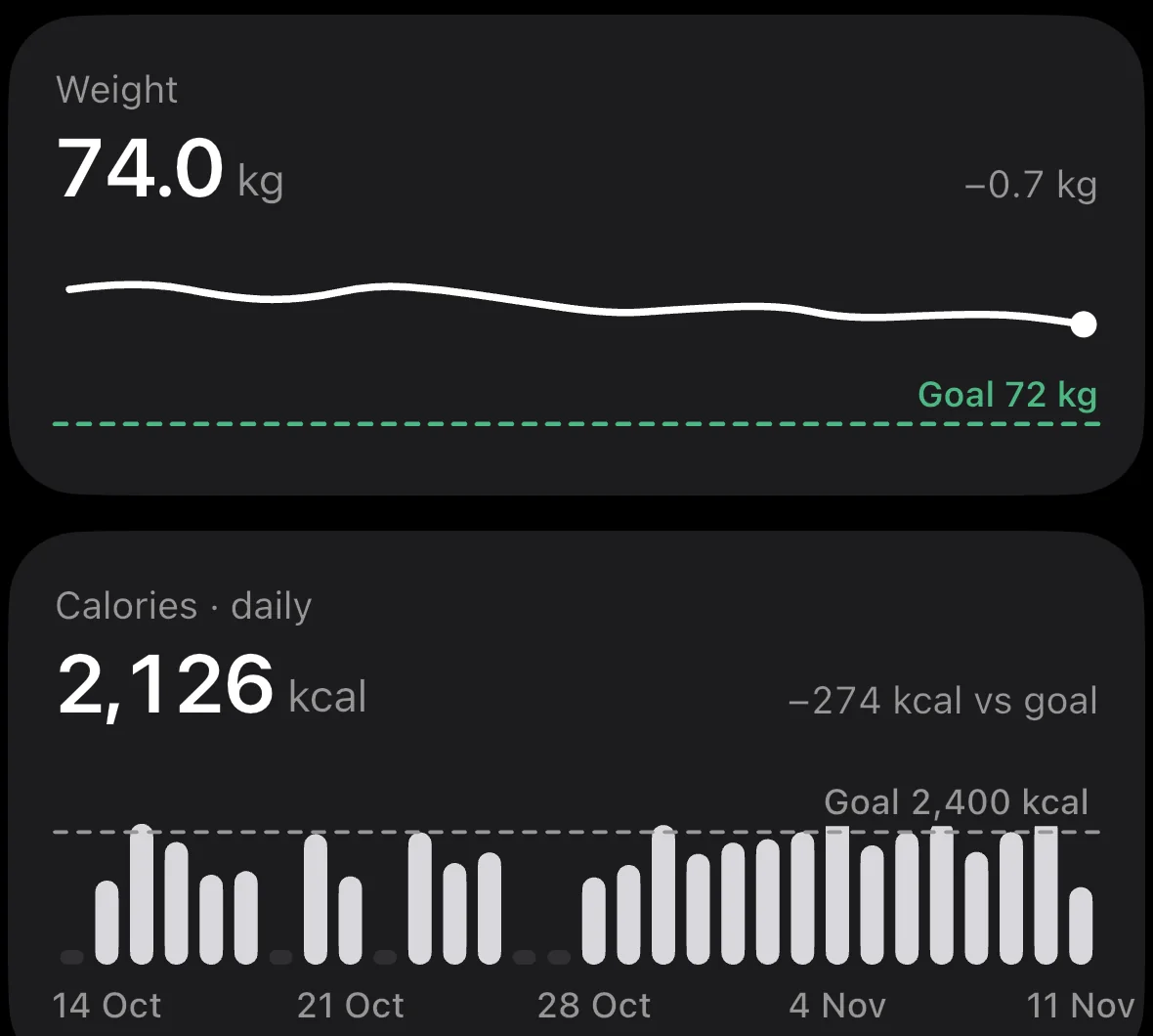
In PeakBFF you set your goal, activity level and weekly pace, then log food by photo, in words or by barcode. Your calories for the day sit beside your workouts, and the weight trend shows how the plan is going.


From a pace to a daily deficit
A calorie deficit is the gap between what you eat and what you burn. This calculator starts from the pace you want, written as a share of your bodyweight per week, and works backward to the gap that pace needs.
The steps: weekly change in kg = pace ÷ 100 × bodyweight. Daily deficit = weekly change × 7,700 ÷ 7, because the engine counts about 7,700 kcal per kilogram of body mass. Target = your maintenance calories minus that deficit. At 80 kg and 0.5 percent a week, that is 0.4 kg a week, a deficit of 440 kcal a day, and 2,319 kcal for a man whose maintenance is 2,759.
The three paces
The pace buttons are the ones in PeakBFF's onboarding: Steady, Recommended and Faster, one step apart. From a BMI of 25 they are 0.5, 0.75 and 1 percent of bodyweight a week. Below a BMI of 25 they are 0.25, 0.5 and 0.75 percent, so no one near a healthy weight is offered an aggressive plan. A pace is capped at 1 percent a week.
A smaller pace means a smaller deficit, which is usually easier to hold and leaves more food on the plate. A faster pace gets there sooner but asks more of you every day. Weight does not fall in a straight line either: water and food in the gut make the scale jump around from one day to the next.
Weeks to your goal, and the healthy-weight floor
Weeks to goal is the weight to lose divided by the weekly change, rounded up to a whole week and shown between 2 and 80. It assumes the same pace the whole way. In practice the weekly change shrinks as you get lighter, because the pace is a share of your current weight, so treat the date as an estimate.
A goal weight is never set below BMI 18.5 for your height, which is the lower end of the healthy range. If you type a lower number the calculator uses that floor and says so. If you are already under it, the goal stays at today's weight. The calculator also never shows fewer than 1,200 kcal a day. If your result would be lower, it shows 1,200 and flags it.
Why 7,700 is a rule of thumb
The 7,700 kcal per kilogram figure is a simple way to turn a pace into calories. Modeling work on body weight shows that the response to eating less is slow and that expenditure falls as weight comes down, so the true deficit needed changes over time. That is why the answer is a starting point to check against your scale, not a promise.
Calorie deficit questions
How big should my calorie deficit be?
Why does the calculator stop at 1 percent a week?
Why did it change my goal weight?
Does a deficit work the same for everyone?
Can I use it to gain weight?
Are my numbers stored?
Mifflin MD, St Jeor ST, et al. Am J Clin Nutr, 1990: A new predictive equation for resting energy expenditure in healthy individuals.Hall KD, et al. Lancet, 2011: Quantification of the effect of energy imbalance on bodyweight.