FFMI Calculator (Fat-Free Mass Index)
Enter your height, your weight and your body fat percent, and get your fat-free mass index (FFMI) and your normalized FFMI. No body fat number yet? Enter tape measurements and the calculator works it out with the US Navy method. Your FFMI is only as good as that body fat figure, so it is an estimate. It runs in your browser and needs no account.
From a DXA scan, skinfolds or another source. An estimate is fine.
Example for someone at 178 cm weighing 80 kg with 15% body fat. Enter your own measurements above.

21.6 kg/m²

21.5 kg/m²

68 kg

15 %

12 kg
In Kouri et al. (1995), the normalized FFMI of the 74 male athletes who had not used steroids went up to 25.0. This estimate is at or below that figure.
An estimate: it is only as accurate as the body fat figure behind it. Normalized FFMI adds 6.1 × (1.8 − height in m).
Need a body fat percent first? Try the body fat calculator.
Follow the lifts and the weigh-ins behind it
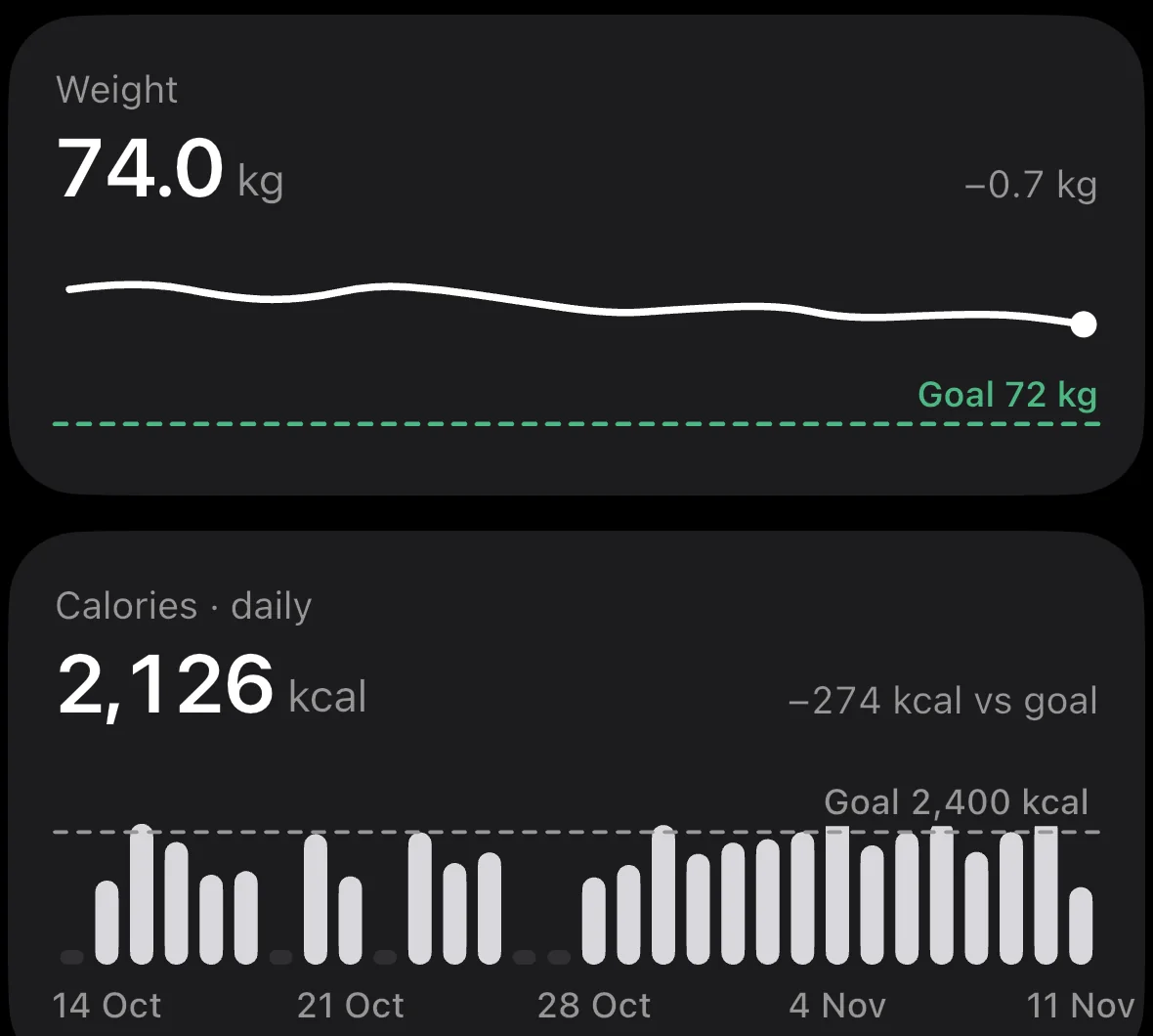
FFMI is a snapshot. PeakBFF logs your sets and keeps your weigh-ins and weight trend, and ranks every lift you log from Iron to Challenger. A weekly check-in can add an optional photo and note to that day's weigh-in, so you can look back at how a change in training matched a change in the scale.


What FFMI is and how it is worked out
FFMI compares your lean mass with your height, the way BMI compares your weight with your height. Take your weight, remove the fat, and divide what is left by your height in meters squared: FFMI = lean mass in kg ÷ height in m².
Normalized FFMI adds a correction so that people of different heights can be compared at the height of a 1.80 m man. The correction used in the 1995 paper by Kouri and colleagues is normalized FFMI = FFMI + 6.1 × (1.8 − height in m). At exactly 1.80 m it changes nothing. Shorter than that it adds a little, and taller it takes a little off.
For example, an 80 kg person at 15 percent body fat who is 175 cm tall has 68 kg of lean mass. Their FFMI is 68 ÷ 1.75², which is 22.2, and their normalized FFMI is 22.2 + 6.1 × 0.05, which is 22.5.
Where your body fat number comes from
FFMI needs a body fat percent, and the result can be no more accurate than that number. You can type one from a DXA scan, a skinfold test or another source you trust. If you have none, the calculator can estimate it from a tape measure with the US Navy equations, using the same inputs as the body fat calculator.
A few points of error in body fat matter more than they look. For an 80 kg person who is 175 cm tall, a body fat figure 4 points higher removes 3.2 kg of lean mass and lowers FFMI by about 1.0. If you are comparing yourself with a figure from a study, use a body fat measurement made in a similar way to the study's.
What the research behind the number 25 says
FFMI became well known through Kouri and colleagues (1995), who studied 157 male athletes: 83 who had used anabolic-androgenic steroids and 74 who had not. The normalized FFMI of the men who had not used steroids went up to 25.0. A group of 20 Mr. America winners from 1939 to 1959, estimated in the same way, averaged 25.4. Many of the steroid users in the sample were above 25, and some were above 30. The authors called their findings preliminary.
The 74 comparison athletes were relatively lean and recreationally trained, with an average body fat of 12.5 percent. A later study of 235 American college football players found 62 of them (26.4 percent) above 25, with a highest value of 31.7. Its 97.5th percentile was 28.1, and the authors proposed that figure as a better upper reference for that group. Drug testing was not done in that study.
So 25 is a figure from one small study of male athletes, not a rule that applies to everyone. The calculator tells you where your result sits compared with that figure and leaves it there.
What to do with your result
Use FFMI as one way to follow your own progress. If your weight rises while your body fat estimate stays level, your FFMI rises, which suggests that more of the change is lean mass. Before reading anything into one change, repeat the measurement the same way.
FFMI says nothing about strength, skill or health, and it does not replace seeing your lifts and weigh-ins over months. Because the 1995 study included only men, treat the comparison with 25 as men's data. The formula itself works for anyone, and the result is still an estimate.
- Measure body fat the same way each time you recheck.
- Compare normalized FFMI between people of different heights, and plain FFMI for yourself over time.
- Treat the result as rough if the body fat figure behind it is a guess.
FFMI questions
What does FFMI stand for?
What is the difference between FFMI and normalized FFMI?
Is 25 the natural limit?
How accurate is my result?
Does it work for women?
Does it include a tape-measure option?
FFMI and the 25.0 figure: Kouri, Pope, Katz & Oliva (1995), Clinical Journal of Sport Medicine 5(4):223-8. Fat-free mass index in users and nonusers of anabolic-androgenic steroids.FFMI in college football players (62 of 235 above 25; 97.5th percentile 28.1): Trexler et al. (2017). Fat-free mass index in NCAA Division I and II collegiate American football players.Navy body fat equations and measuring sites: Department of Defense Instruction 1308.3 (2002), enclosure 3. DoDI 1308.3 (PDF).Military circumference method versus DXA in 609 Marines: Potter et al. (2022), Frontiers in Physiology. Circumference-based predictions of body fat revisited.