One Rep Max Calculator
Enter the weight you lifted and how many reps you got. The calculator estimates your one rep max and shows the weights at 50 to 100 percent of it, in kg or lb.
1 to 30
Enter the weight and reps from a set to see your estimated one rep max.
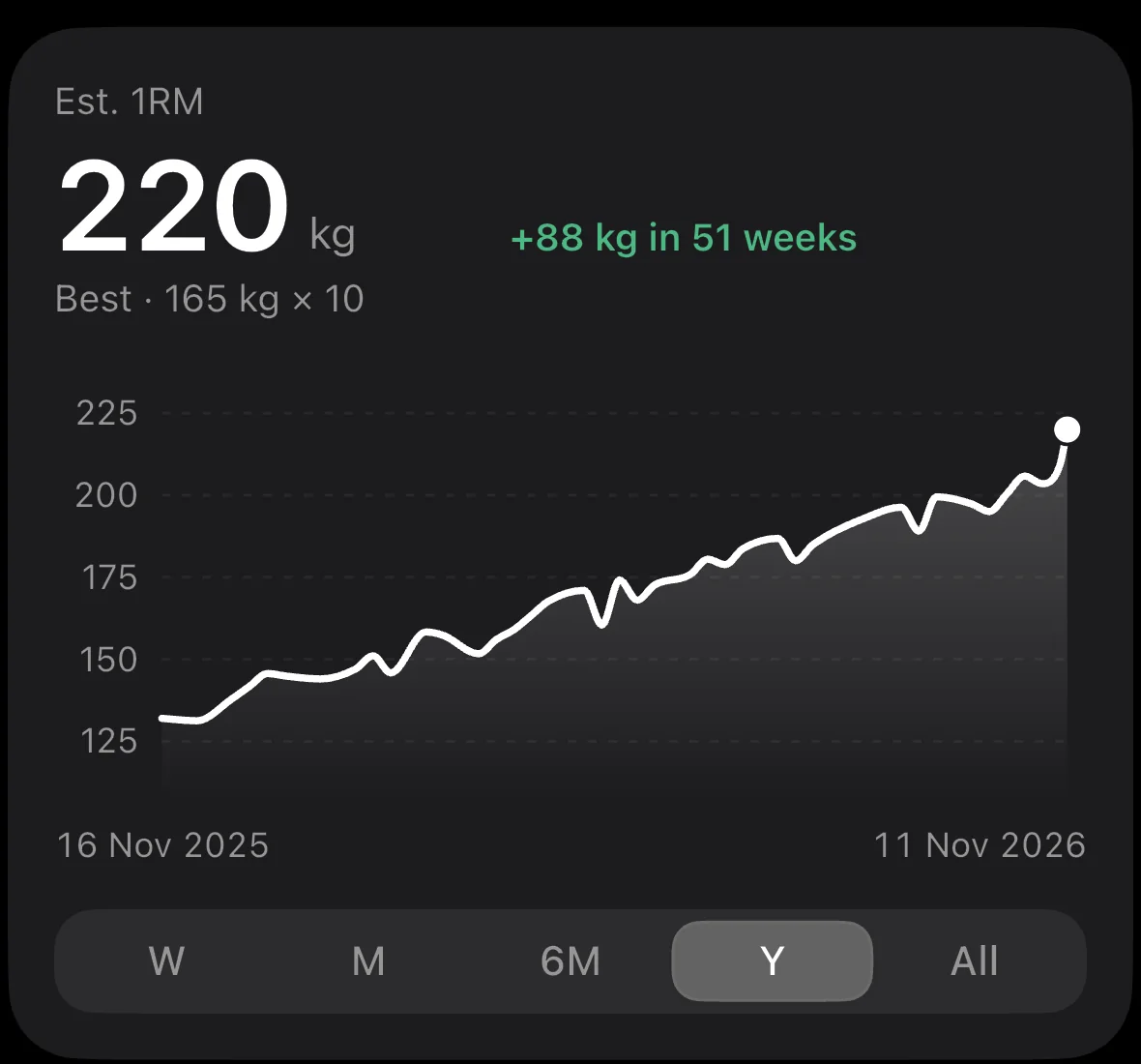
Track your estimated 1RM over time
PeakBFF charts your estimated 1RM for every lift you log, and keeps your workout log, rest timers and personal records in one place.


The formula
This calculator uses the Epley formula, the same one PeakBFF uses to estimate a one rep max from a logged set: weight × (1 + reps ÷ 30). With one rep, the estimate is the weight itself.
For example, 100 kg for 5 reps gives 100 × (1 + 5 ÷ 30), which is 116.7 kg. The maths works in any unit, so 225 lb for 10 reps gives 300 lb.
How to get a good estimate
Use a set you took close to failure, with good form and a full range of motion. The estimate is most trustworthy for sets of about 2 to 10 reps. Very high rep sets depend heavily on fatigue and technique, so the number drifts further from a true max. The calculator accepts 1 to 30 reps.
An estimate is not a prediction you should test on the day. If you want to find a true one rep max, warm up well, add weight in small steps and use safeties or a spotter.
Using the percentage table
Programs often prescribe work as a percentage of your one rep max. The table lists every 5 percent from 100 down to 50, in your unit. Where a typical rep count is well known, it is shown beside the weight: about 2 reps at 95 percent, 4 at 90, 6 at 85, 8 at 80, 10 at 75, 12 at 70 and 15 at 65. These are rough guides. People vary, and so do exercises.