Protein Calculator
Enter your bodyweight and how you train. You get a daily range in grams, based on the International Society of Sports Nutrition's position stand, with a per-meal figure. For most people who lift, that range is 1.4 to 2.0 g per kg.
The ISSN range for most exercising people.
Example for a 75 kg bodyweight. Enter your own numbers above.
105–150 g
1.4 to 2 g per kg
at 75 kg
35–50 g
26–38 g
PeakBFF target
135 g
The app's target is inside this range.
The ISSN range for most exercising people. PeakBFF's balanced target is 1.8 g per kg. An estimate for healthy adults, not medical advice.
Related results
- Work out your maintenance calories. TDEE calculator
- Turn a weekly pace into daily calories. calorie deficit calculator
- Split your calories into protein, carbs and fat. macro calculator
Check your protein as you eat
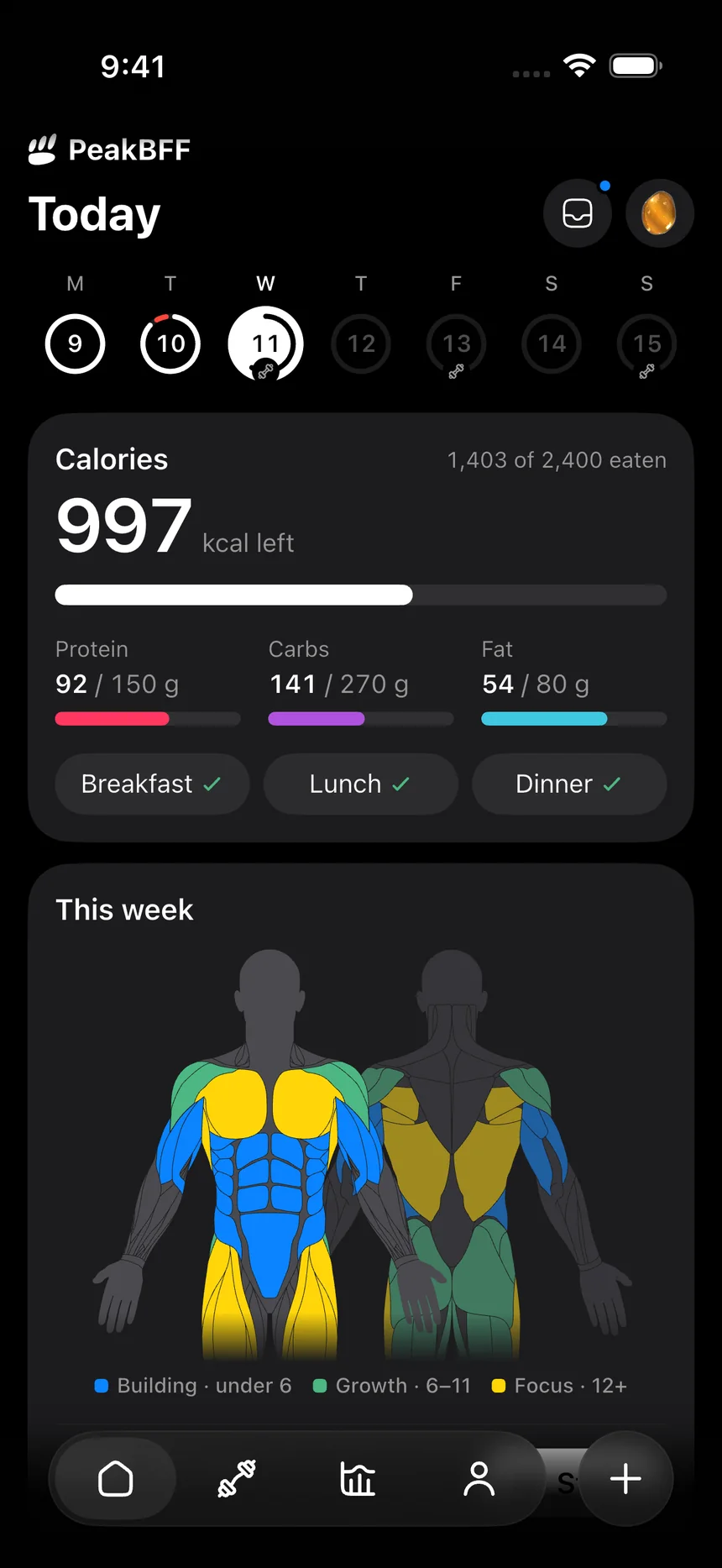
Log a meal in PeakBFF with a photo or a short description and see its protein. Many features, including food logging, are free, and full macro detail is part of PeakBFF Plus.


Where the ranges come from
Protein needs are set per kilogram of bodyweight, so the maths is a multiplication. The page offers three bases. For adults who do not train, the recommended daily allowance is 0.8 g per kg. For people who exercise, the ISSN position stand on protein and exercise says 1.4 to 2.0 g per kg a day is enough for most to build or keep muscle.
The third basis is for resistance-trained people eating fewer calories. The same position stand says higher intakes, 2.3 to 3.1 g per kg, may help them retain lean mass while in a deficit. That is the top of the evidence for a range, and it asks a lot of your food budget.
What your range looks like
At 80 kg, the training range is 112 to 160 g a day. PeakBFF sets protein targets at 1.8 g per kg for its balanced preset, which is 144 g at 80 kg, inside that range, and 2.0 g per kg for its low carb preset.
A range is more useful than a single figure because your body does not need an exact number. Near the low end you are likely covered. Near the high end you may get more from the margin when you are cutting or lifting hard.
Spreading it across meals
The position stand suggests about 0.25 g of high-quality protein per kg per meal, or an absolute dose of 20 to 40 g, spread across the day. The calculator divides your daily range by the number of meals you choose so you can see what each plate needs. Four meals of 28 to 40 g reach 112 to 160 g.
Whole foods can supply all of it: meat, fish, eggs, dairy, tofu, beans and lentils. Powders make sense when they save time or calories, not as a requirement.
Which bodyweight to use
The ranges are built for a typical bodyweight. If you carry a lot of extra weight, calculating from a goal weight, or from your lean mass if you know it, keeps the grams from running too high. The calculator uses the weight you enter, so enter the one you want to base the target on.
Protein questions
How much protein do I need a day to build muscle?
Is more protein always better?
Do I need more protein when I am losing weight?
Can I hit my target with food alone?
Does this replace advice from a doctor?
Does the calculator save my weight?
Jäger R, Kerksick CM, et al. J Int Soc Sports Nutr, 2017: International Society of Sports Nutrition Position Stand: protein and exercise.Institute of Medicine, 2005 (protein RDA of 0.8 g per kg): Dietary Reference Intakes for Energy, Carbohydrate, Fiber, Fat, Fatty Acids, Cholesterol, Protein, and Amino Acids.