Strength Level Calculator
Pick a lift, enter your bodyweight and a set you have done, and see where it ranks from Iron to Challenger. It uses the same standards and the same maths as the PeakBFF app, runs in your browser, and needs no account.
Enter your bodyweight, the weight and your reps to see your rank.
Rank every lift you log
PeakBFF ranks every lift you log, Iron to Challenger, and gives each muscle a rank too. Log your sets in the app and watch the ranks move.


How your strength level is calculated
For lifts that use a weight, the calculator first estimates your one rep max with the Epley formula: weight × (1 + reps ÷ 30), or just the weight for a single rep. It then divides that estimate by your bodyweight raised to a power that is set for each lift and each sex, so lifters of different sizes can be compared fairly. Lifts done for reps, like push-ups, are scored on the reps themselves.
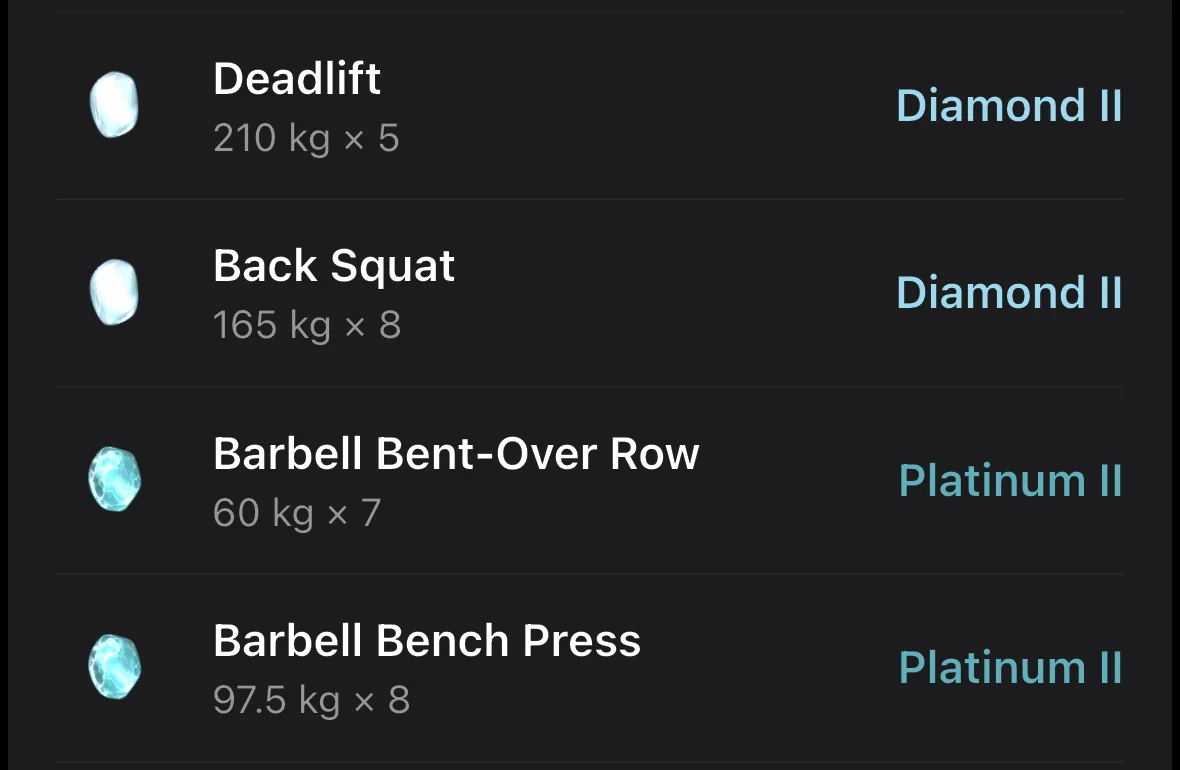
The result is placed between the tier boundaries for that lift. There are ten tiers: Iron, Bronze, Silver, Gold, Platinum, Emerald, Diamond, Master, Grandmaster and Challenger. Every tier below Challenger is split into three divisions, III, II and I, so you can see small steps forward.
Where the standards come from
For the back squat, bench press and deadlift, the boundaries are percentiles of raw, drug-tested powerlifting results from the OpenPowerlifting dataset. Challenger starts at the 99th percentile of that group.
Incline bench press, overhead press, pull-ups, chin-ups and dips use percentiles from self-reported gym lifters. Most other lifts are modeled from a related lift that has measured data, and machine and cable lifts only compare with the same setup. The page tells you which kind of benchmark your lift uses.
How to use it
Choose the lift, then enter your bodyweight, the weight you lifted and the reps you completed. A hard set close to failure gives the fairest estimate. Dumbbell lifts take the weight of one dumbbell. For pull-ups, chin-ups and dips, enter the total weight you moved, which is your bodyweight plus anything you added. Leave it blank and the calculator uses your bodyweight alone.
Weighted lifts accept sets of 1 to 12 reps, and rep-based exercises accept up to 100. Outside the range for a lift, the calculator says it cannot rank the set instead of guessing.
- Estimated 1RM is a calculation, not a tested max. It is least reliable for high-rep sets.
- Progress shows how far you are through your current tier.
- Next step shows what estimated 1RM reaches the next division.
Strength level questions
Is this the same rank I would get in the PeakBFF app?
What do the tiers mean?
Why does bodyweight matter?
Why was my set not ranked?
Why are there male and female options?
Does this tool save my numbers?
Powerlifting standards: OpenPowerlifting data (CC0). Gym lifter standards: Powered by FitnessVolt.