Macro Calculator
Enter your details and goal to get daily calories and a split into grams of protein, carbs and fat. Choose a preset and see how the split changes. It is the same split the PeakBFF app uses for its targets.
Moderate exercise 3-5 days/week
0.5% of bodyweight a week, about 0.38 kg.
Example for a 30-year-old man at 175 cm and 75 kg. Enter your own numbers above.
2,221
kcal a day
Lose · 0.5%/wk
Balanced split: 1.8 g/kg protein, 30% of calories from fat. Each bar is the macro's share of your calories (10 segments are all of them).
Share of calories: 24% protein, 46% carbs, 30% fat.
Protein is set by bodyweight, fat as a share of calories, and carbs take the rest (protein and carbs 4 kcal per gram, fat 9). An estimate.
Related results
- Your maintenance is about 2,633 kcal. TDEE calculator
- Weekly pace: about 0.38 kg. calorie deficit calculator
- See the evidence-based protein range. protein calculator
See your macros against the day
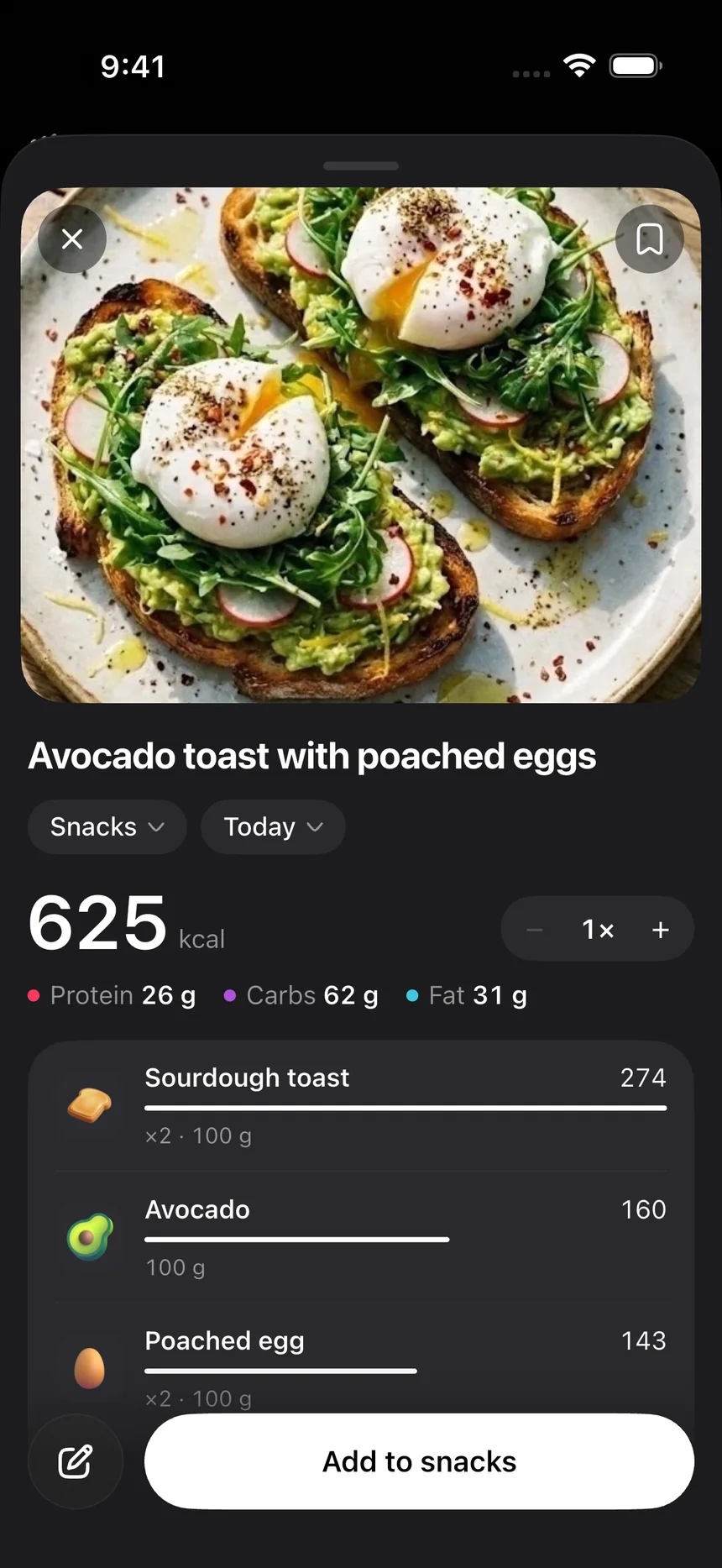
PeakBFF logs a meal from a photo or a description and shows calories, protein, carbs and fat. Full macro detail is part of PeakBFF Plus. Many features, including food and workout logging, are free.


How the split is built
Macros are worked out after calories. First comes the daily calorie target for your goal. Then protein is set by bodyweight, fat is set as a share of the calories, and carbohydrate gets whatever is left. Protein and carbs count 4 kcal per gram and fat counts 9.
For a balanced split at 2,000 kcal and 80 kg: protein is 1.8 × 80 = 144 g (576 kcal), fat is 30 percent of calories (600 kcal, about 67 g), and carbs take the remaining 824 kcal, about 206 g.
The four presets
Each preset sets two numbers: grams of protein per kilogram of bodyweight, and the share of calories from fat.
- Balanced: 1.8 g/kg protein, 30 percent of calories from fat.
- Low fat: 1.8 g/kg protein, 20 percent from fat, so more carbs.
- Low carb: 2.0 g/kg protein, 40 percent from fat.
- Keto: 1.8 g/kg protein, 70 percent from fat, which leaves carbs very low.
When the numbers do not fit
A small calorie target with a heavy body can leave too little room: protein and fat together would be more than the whole budget. In that case the calculator trims fat first so carbs never go below zero, and the protein figure stays where bodyweight put it. You will see this on a very low target with the low carb or keto preset.
There is no single correct split. Protein has the strongest case for a fixed target; for carbs and fat, the best split is the one you can follow consistently. Picking a preset is a way to start, and you can adjust grams to match how you eat.
Using macros day to day
Hitting every gram on every day is not the aim. Many people check protein first, then let calories decide the rest. Looking at a week of logged food shows far more than any single day. Foods rarely arrive with round numbers, so a few grams either way does not matter.
Macro questions
What are macros?
How many calories are in a gram of each macro?
Which preset should I pick?
Do the macros change if I switch from losing to gaining?
Why is my protein the same at two different calorie targets?
Is this medical advice?
Calories and the split follow the PeakBFF nutrition engine; energy factors per Atwater. Resting energy: Mifflin MD, St Jeor ST, et al. Am J Clin Nutr, 1990: A new predictive equation for resting energy expenditure in healthy individuals.Jäger R, et al. J Int Soc Sports Nutr, 2017: International Society of Sports Nutrition Position Stand: protein and exercise.