TDEE Calculator
Your TDEE, or total daily energy expenditure, is the estimated number of calories you burn in a day. Eat about that much and your weight should hold steady. Enter your details to see your estimate, and what it would be at each activity level.
Moderate exercise 3-5 days/week
Example for a 30-year-old man at 175 cm and 75 kg. Enter your own numbers above.
2,633
kcal a day to maintain (TDEE)
1,699 × 1.55 · moderately active

1,699 kcal

×1.55
TDEE at each activity level
An estimate from the Mifflin-St Jeor equation. Real expenditure varies from person to person.
Related results
- Losing weight at the recommended pace: about 2,221 kcal a day. calorie deficit calculator
- Split your calories into protein, carbs and fat. macro calculator
- Protein for training: about 105 to 150 g a day. protein calculator
Set your calorie target in the app
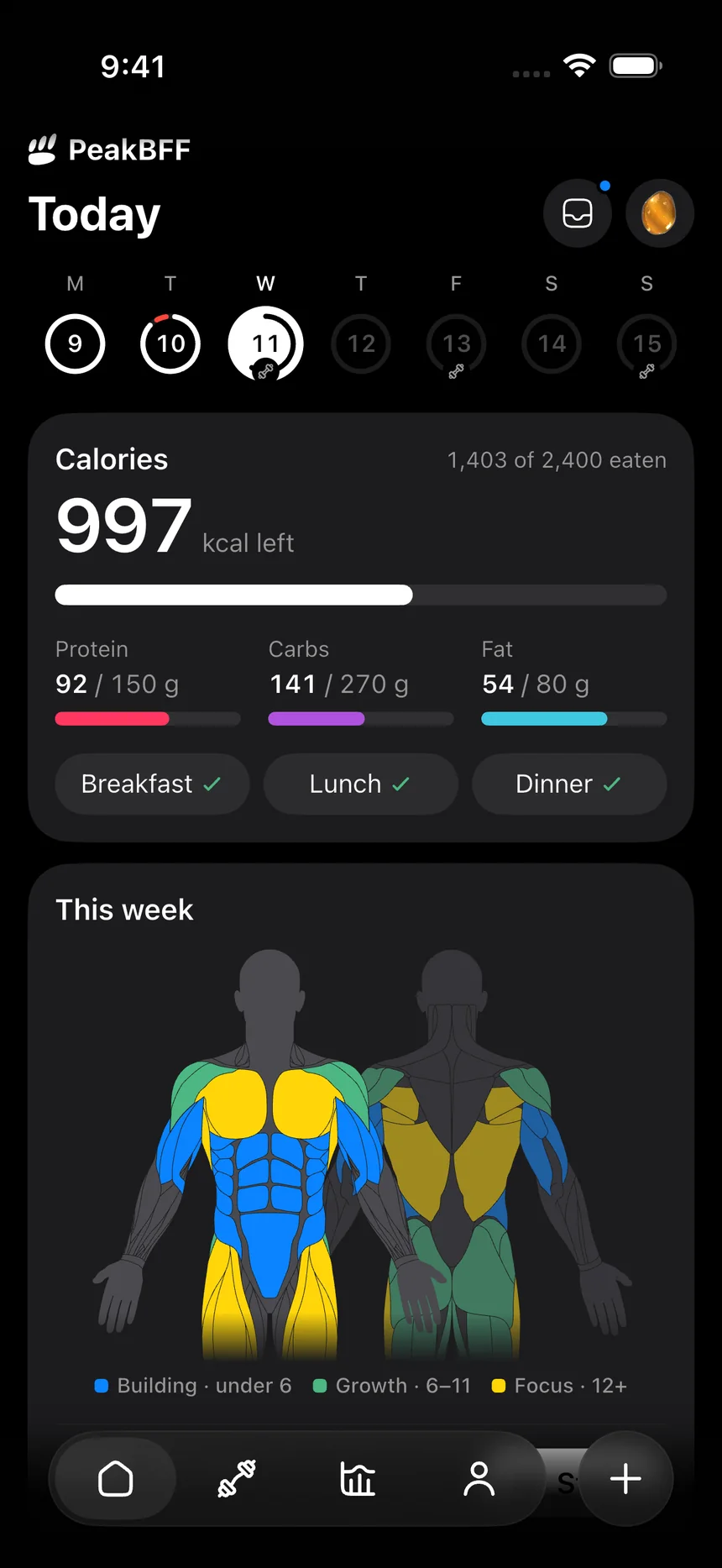
PeakBFF uses the same equation and activity levels to set your daily calories from your goal and weekly pace. Log meals by photo, in words or by barcode, and see your day against that target next to your workouts.


How your TDEE is estimated
The calculator works in two steps, the same two the PeakBFF app takes when it sets up your calorie target. First it estimates your resting energy, the calories your body uses at rest, with the Mifflin-St Jeor equation: 10 × weight in kg + 6.25 × height in cm − 5 × age in years, then + 5 for men or − 161 for women.
Second, it multiplies that resting figure by an activity factor to cover everything else you do in a day. The result is your maintenance calories. For a 30-year-old man who is 180 cm and 80 kg, resting energy is 1,780 kcal. At a moderate activity level (× 1.55) his TDEE is about 2,759 kcal.
Choosing an activity level
The activity factor is the part people get wrong most often, and it moves the answer more than any other input. Pick the level that matches a normal week, not your best one. Time spent sitting at a desk counts, and so do the days you skip training.
- Sedentary (× 1.2): little or no exercise.
- Lightly active (× 1.375): light exercise 1 to 3 days a week.
- Moderately active (× 1.55): moderate exercise 3 to 5 days a week.
- Very active (× 1.725): hard exercise 6 to 7 days a week.
- Extremely active (× 1.9): very hard exercise or a physical job.
Why it is an estimate
In a review of equations for resting metabolic rate, Mifflin-St Jeor predicted the measured value to within 10 percent for more people than the alternatives did. That is the best case: within 10 percent on a 2,500 kcal day is a range of 250 kcal either way, and some people fall outside it.
Your real TDEE also shifts with muscle mass, daily steps, sleep, and how long you have been eating less. Treat the number as a starting point. Eat near it for two or three weeks while you weigh yourself, and adjust by what your weight does, not by what a formula says.
What to do with your TDEE
Eat at your TDEE to maintain your weight. Eat below it to lose weight, or above it to gain. The size of that gap is a choice of pace, and the calorie deficit calculator turns a weekly pace into a daily calorie number. The macro calculator then splits any calorie number into protein, carbs and fat.
TDEE questions
What is the difference between BMR and TDEE?
Is TDEE the same as maintenance calories?
Should I count my workouts in the activity level?
Why does my TDEE look different on other calculators?
How often should I recalculate?
Does the calculator save my numbers?
Mifflin MD, St Jeor ST, et al. Am J Clin Nutr, 1990: A new predictive equation for resting energy expenditure in healthy individuals.Frankenfield D, Roth-Yousey L, Compher C. J Am Diet Assoc, 2005: Comparison of predictive equations for resting metabolic rate in healthy nonobese and obese adults.